Today at Open Forum, we were pleased to welcome Sara Beth Freytag. She talked about her passion for nature and wildlife and how that passion has impacted her life. Sara Beth was born in Kentucky and has loved nature ever since she was a little girl. This love ended up guiding her academic interests. She attended the University of Kentucky where she earned a master’s in forestry. At that point, however, Sara Beth began to feel that the world of scientific research was not the right way for her to go, so she pivoted her focus towards education.
Now Sara Beth is the Coordinator of Children and Youth Education at Hobcaw Barony where her focus is teaching ecology (the study of relationships of organisms to their environment) through special programs and summer camps. Hobcaw Barony is a local historical property and research center dedicated to educating visitors about the history of the our area, as well as conducting research into wildlife, ecology, and forestry.
Sara Beth ended her visit by leading us outside to play a game called Bats and Moths. The game gave us an opportunity to learn about how bats navigate through echolocation. First, everyone stands in a big circle to represent a forest. Then, two people volunteer to represent moths and one person volunteers to play a bat. Similar to the game Marco Polo, the bat is blindfolded and has to use the sounds of the two moths clapping to figure out where they are and tag them.
Sara Beth’s presentation demonstrated how her interests led her into working a fulfilling career where she gets to do what she loves every day. She showed us how our own personal talents through passion and education can inspire the next generation.
Today at Open Forum we welcomed Mr. Jeremy Vause. Mr. Vause is a multifaceted performer, music educator, and small business owner who was born here in Georgetown.
When Mr. Vause graduated high school he didn’t know what he wanted to do with his life. “Music was the only thing I was passionate about at the time,” he said. So, he went to CCU and got a bachelor’s degree in music. After college, Mr. Vause became a choir section leader at Prince George Winyah Church in Georgetown and began building his small business. Today he gives piano, singing, acting, and public speaking classes.
As is often required when pursuing a career in the performing arts, he had to work a “survival job” (salesperson at Radio Shack) until music could pay the bills. He later became music director at Prince George, quit his retail job, and saw his business begin to grow.
One day, Mr. Vause saw a casting call for a horror movie that was filming in Georgetown that needed extras (Barry Levinson’s The Bay). He got on their list and had a great time playing a dead body in the street. He discovered his love for acting and being on set. “It was the coolest day of my life!” he said. He started responding to more casting calls and went to SCAD to earn an MFA in acting. He signed with a talent agent, and has since been in many more films, series, commercials, and skits. Some notable examples are Walking Dead, One Tree Hill, and Army Wives.
Some of Mr. Vause’s other “side quests” have included: online piano/voice teaching during Covid and beyond, teaching elementary school music, and getting certified in the Miller Voice Method for public speaking. As Mr. Vause later explained, it’s important to not limit yourself to one thing, and to always continue building your repertoire. “Be a life-long learner,” he told us. “Stay open to possibility.”
Mr. Vause’s professional journey continues to this day, and he remains cheerful and optimistic. “You don’t have to have your career planned out,” Mr. Vause said, “you just have to be brave enough to start.”
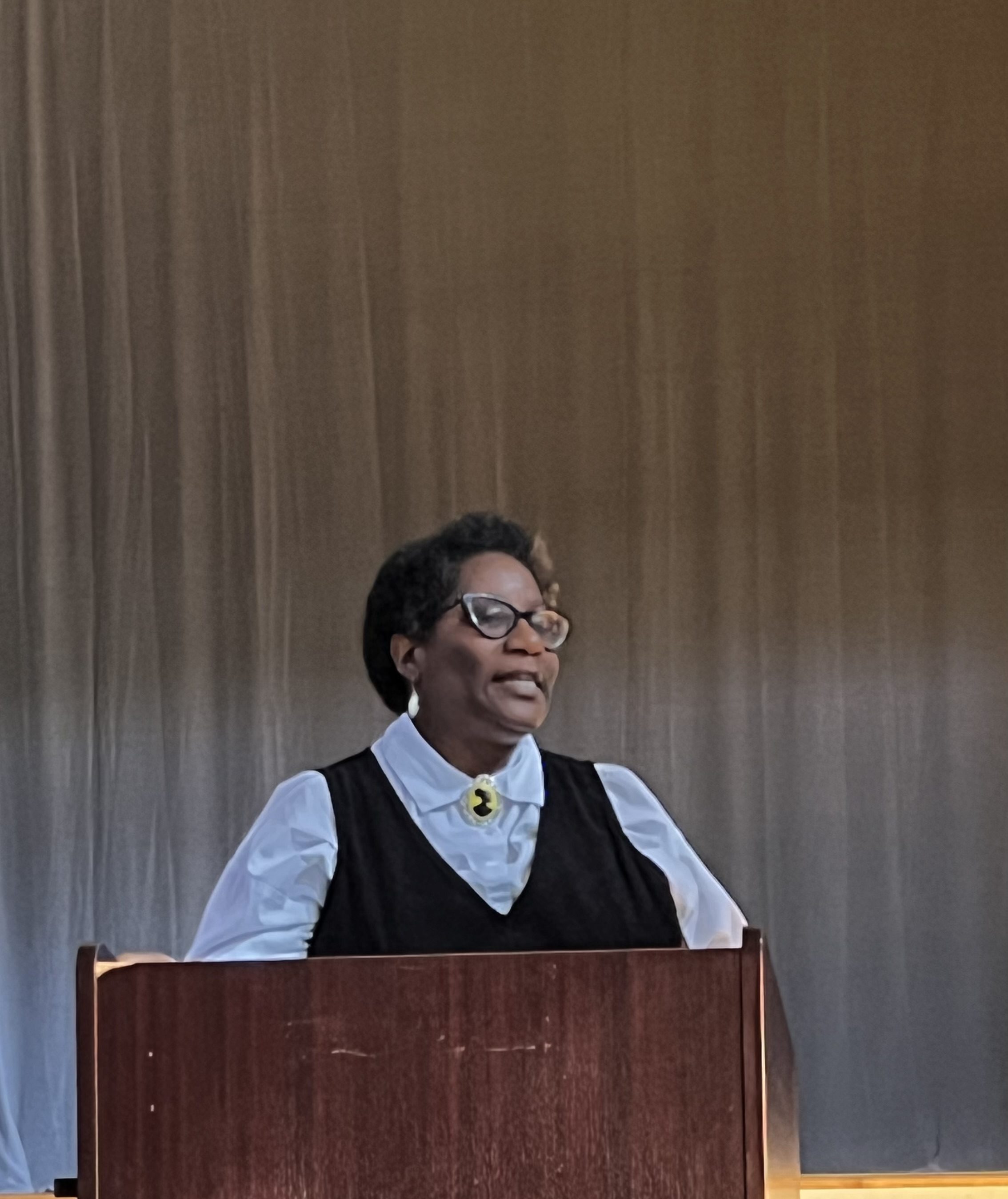
On October 21, we had the pleasure of welcoming Beatrice Rodrigues of the Gullah Museum. Ms. Rodrigues is a historian who is dedicated to preserving the history of the Gullah Geechee people. She also serves as a co-chair of the Middle Passage Ceremony and Port Markers Project. Ms. Rodrigues’ presentation at Open Forum brought an often painful chapter of history closer to home, revealing the deep connections between the slave trade and the history of Georgetown. The first enslaved people began arriving through the Middle Passage in 1526, exactly 500 years ago.
Ms. Rodrigues told us that the Middle Passage was the forced voyage across the Atlantic Ocean endured by millions of Africans who were kidnapped, sold, and transported into enslavement. Approximately 12.5 million Africans were forced onto ships during the transatlantic slave trade, and about 10.7 million survived the voyage. Behind these numbers were individuals whose names, families, and personal histories were often lost. Ms. Rodrigues told us that these individuals had lives before enslavement, including communities they loved, knowledge they carried, and futures that were taken from them. Their identities did not begin with their captivity, and nor should their stories end there.
Ms. Rodrigues’ work helps recover their stories. Using historical shipping records, she examines individual voyages, dates, ports, ships, and whatever documentation has survived. These records help us better understand the people caught in this system, as well as the individuals who profited from it. Ms. Rodrigues taught us about four ships that brought captives to Georgetown: the Warwick in 1737, carrying eight captives; the Endeavour in 1738, carrying 30; the Susanna in 1767, carrying 13; and the Betsey in 1784, carrying 19.
The Middle Passage Ceremony and Ports Marker Committee works to highlight the 500th anniversary of this infamous route. Thanks to the commmittee’s efforts, Georgetown’s boardwalk is now home to a new historical marker which will educate the public about Georgetown’s role in this part of history. Ms. Rodrigues’ work helps ensure that the stories of those who endured the Middle Passage are not forgotten and that future generations understand how this history continues to shape our region.
The Gullah Geechee people and their cultural heritage remain an essential part of our region’s identity. Their agricultural expertise, language, food ways, traditions, and community practices reflect generations of African cultural influence, adaptation, and resilience.
Our guest Nancy Cave is a political activist. She served as the executive director of the Coastal Conservation League for fifteen years. The CCL works to preserve our coastal environment by purchasing land for preservation and by lobbying against overly aggressive development and industrial pollution. “We are advocates for environments,” she said.
Mrs. Cave said that the CCL protects land, shores, communitites and plants. For example, in the early 2000s, a coal plant was planned on the PeeDee River out in Florence County. Coal plants are notorious polluters because they release mercury into the water. Mercury can cause brain damage and illness in fish and people who eat the fish. This proposed coal plant would have had terrible consequences for anyone and anything downstream in Williamsburg and Georgetown County.
The CCL decided that the plant had to be stopped. Mrs. Cave met with Florence people who were against the idea and a local woman named Terry Cook became the biggest anti-coal plant advocate. Mrs. Cave and Terry organized everyone to write letters to congresspeople and powerful politicians. They visited the governor. They started a letter-writing campaign to the members of the proposed plant’s Board. They spoke up at council meetings and also sued to stop construction.
“The law is a very important tool in the toolbox,” Mrs. Cave said.
Using lawful challenges and intense public pressure on board members and prominent South Carolinians, they finally achieved their goal: the plan to build a coal plant on the Peedee was scrapped in 2009. “We aggravated them so much they decided not to go forward,” Mrs. Cave said, smiling. “That was the last coal plant [planned] to be built in the United States.”
Mrs. Cave has paid a price for her environmental activism. When she opposed the placement of groins in the ocean at DeBordieu, many of her neighbors became angry and threatening. But she did not back down.
“You need to speak up and speak out for what you believe,” Mrs. Cave told us. Mrs. Cave’s message was very inspiring and helps us understand that we have power.
On September 30th, we welcomed our speaker, Steve Williams, a journalist and local historian who researches and publishes on the rich history of our area. “Steve Williams,” said Dr. Gates, “brings things to light that would otherwise be left in the dark.” Mr. Williams introduced us to two heros—one who is honored and one who deserves honor: Florence Nightingale and Florence Williams.
Everyone has hear of Florence Nightingale, the “woman with the lamp” who improved care for the sick in the nineteenth century. She was born into a wealthy and leisured family but at age sixteen heard the voice of God telling her to help people. This extraordinary and intelligent person decided to be a nurse in a time when nursing was not even a profession. After getting as much medical training as she could, Florence was assigned to the military hospital in Scutari, Turkey, during the Crimean War.
This hospital was in terrible condition—rats everywhere, soldiers dying of disease and infection, insufficient beds. Florence Nightingale and her team of trained nurses immediately got to work, cleaning and organizing. She kept meticulous records, documenting the circumstances of each patient and each death. Improvements in the care and facilities led to improved outcomes for the soldiers. Under Florence Nightingale’s supervision, the soldiers’ death rate dropped from 42% to 2%. The soldiers called her the “lady with the lamp” because she would carry a small oil lamp while caring for them at all hours of the night.
Mr. Williams then introduced us to Florence Williams, who lived in Georgetown during the Depression and was also a nurse. Georgetown didn’t have a hospital at that time—if you were very sick, you had to be treated at McLeod Hospital in Florence.
God visited Florence Williams in a dream and told her there was great work for her. When the hospital she was working at closed, she came back to Georgetown and used the spare rooms in her in her large home on Duke Street to shelter the sick people of Georgetown. Her house had 25 beds, a surgery, and two wards. It stayed open until the 1950s, when Georgetown Memorial was built. Florence Williams deserves to be honored for her kindness and service to the people of Georgetown.
Mr. Williams was struck by similarities between Florence Williams and Florence Nightingale. They were both nurses, they both received a divine calling, they both helped people, they both defied social limitations, and they both embodied greatness. He closed by sharing his favorite Dr. King quote: “Anyone can be great; all you need is a heart full of love and a heart full of grace.”
We look forward to joining Mr. Steve Willliams when a historical marker is placed in front of the lot where Florence Williams’ house used to stand, to honor her memory and be inspired by her kindness.
What a pleasure to welcome back Qulex Dickerson, TGS Class of 2020! Qulex was a friend to all when he was here. He filled us in on how his life has been going since graduating from TGS.
Qulex graduated from Coastal Carolina University in 2024 with a degree in Graphic Design. Jobs in graphic design seemed to be scarce then, so he began working at the YMCA, educating kids and running the after-school program. Today, Qulex works for the non-profit Friendship Place in Georgetown.
Friendship Place aids families / neighbors in the community with programs such as Georgetown Eats, Georgetown Lives, Georgetown Prays, and Georgetown Learns. This organization helps move people “past crisis to self-sufficiency.” Qulex told us we could help at Friendship Place by volunteering to serve food. We can also contribute to the “blessing boxes,” which contain free soap, deodorant, and other personal items which people in our community may lack.
Qulex has good memories of Dr. Simmon’s classes (British and American Literature). He laughed when he recalled a project they all did on James Dickey’s novel Deliverance. “It was the only grade I got a 100 on!”
Qulex’s visit was a reminder that school doesn’t last forever. “Stay consistent,” he told us. “Stay focused.” It’s great to enjoy the success of a Kingfisher!
Andy Friedman spoke to us during Open Forum today. He is a financial adviser at Raymond James and a member of the Board of TGS. He talked about how starting to invest early is a good strategy for young people. He also revealed to us how to become a millionaire by the time we retire.
Mr. Friedman’s job is helping clients have enough money for a comfortable retirement. He told us that in South Carolina today, a person probably needs about $989,658 saved up to stop working. Of course, that number is for someone in today’s economy—not the economy in which our students will retire 50 years from now. Mr. Friedman explained how inflation devalues what people save (prices have risen on average 3% each year since 2006). Because of inflation, by the time current 15-year-olds are ready for retirement, they will need about $2.43 million. “That’s a lot of money,” Mr. Friedman said.
This sum is truly a ton of money, but Mr. Friedman explained that it is possible to acquire it. He told us how. Basically, young people must start early and invest regularly and consistently in the stock market. The money will grow more and more easily over the years, due to the “magic” of compound interest. He told us to think of pushing a snowball down a hill—a snowball is hard to get started but as it grows it will start to roll by itself. The money you invest gets increasing returns year over year if you leave it alone.
“Compound interest is considered the eighth wonder of the world,” Mr. Friedman said. “But time is the key.” He gave us a concrete example: if a person had put in $100 in the 1976 market and had added $100/month until 2026, they would have approximately $2.3 million, a very comfortable retirement. He supported this claim with statistics about how the market has performed since 1976—some years it has earned up to 37% returns on investments.
“Waiting will cost you more,” Mr. Friedman told us. “Start early, invest every month, use employer plans, and raise contributions.” Thank you, Mr. Friedman, for your wise advice!
Nobody would ever suspect that our teacher Mrs. Porcher Scott has a rare blood disorder by just looking at her, but she does and it is serious. She raised our awareness of her “invisible disease” today at Open Forum.
In 2003, Mrs. Scott was diagnosed with a condition called ITP (immune thrombocytopenia). ITP is an uncommon blood disorder where a person’s blood has a low or extremely low platelet count. (Platelets are fragments of blood cells that are crucial to the immune system because they form blood clots to help prevent bleeding.) The average person has 150,000 to 450,000 per microliter, but Mrs. Scott has less than 50,000 per microliter. This means that if she got hurt, she could be sent to the hospital for a serious emergency involving internal bleeding.
After being diagnosed, Mrs. Scott was limited to a number of things she could and could not do. “I was scared I would have to live in a bubble,” she said. “How would I live my life?” She had to give up most sports. She is also not allowed to scuba dive or ride roller coasters because of the extreme pressure changes. Mrs. Scott tried multiple different treatments including having her spleen removed. The operation ultimately did not do her any good. “Now I’m one down on my immune system,” she told us.
Sadly, there is no cure for ITP, and doctors can not even explain the cause of ITP. For a long time Mrs. Scott felt alone, isolated. “I thought I was the only person who had it,” she told us. Then she discovered the Platelet Disorder Support Association.
Founded in 1998, the PDSA boosts the lives of people with ITP by raising awareness and educating the public about immune thrombocytopenia and various other platelet illnesses. Mrs. Scott now has her own community whom she can relate to and share her story with. She has been active in the leadership of the PDSA for 16 years, working tirelessly to improve the lives of people with ITP.
To show our solidarity with Mrs. Scott, we are all invited to wear purple on September 25, which is “ITP Awareness Day.”
By Sydney S., photoscourtesy of Marsh Deane, MLNL Media
Award-winning actor Bill Oberst held us in thrall today at Open Forum, treating us to a performance that gave us just a taste of his incredible acting ability.
Bill performed his own story, the story of a struggling 14-year-old boy who suddenly found his place in the world when he discovered the writings of Ray Bradbury. Right in front of us, Bill Oberst turned into his teenage self, riding his bike through Georgetown out to the canal. Filled with hatred, trying to escape the world that was suffocating him, he came across a book on the ground. The tattered, muddy paperback was S is for Space, a book of short stories by Ray Bradbury. The angry teenager opened the book to “Pillar of Fire” and read these words: “He came out of the earth, hating. Hate was his father; hate was his mother.”
Bill kept reading and immediately connected with the character in the book. “Because my pain, my shame were named,” he said, “I didn’t have to carry them anymore.” Bradbury’s writing had literally saved him. “These sentences are the reason I’m standing in front of you,” he said. For Bill, discovering good writing was finding out that he was not alone in the world. Bradbury’s writing allowed Bill to see himself and his flaws in the characters this writer created. Bill urged us to fall in love with language for the sake of our humanity. When we read a great writer, the gap that separates us from each other is bridged.
Bill the angry teenage grew up to be an awesome actor. He has done over 200 films and various TV projects where he is nationally known for portraying dark, complex characters. (His most recognizable role is one of the most notorious criminals in CBS’ hit series Criminal Minds.) Bill has also created one-man stagings of characters such as Jesus of Nazareth, Mark Twain, Ray Bradbury, Lewis Grizzard, and most recently, Satan the Adversary.
Bill’s message to us today was about the importance of language and writing as a channel to our shared authentic humanity. “Fall in love with language,” he told us. “That is a love that will never end.”
Kingfishers gathered in the Auditorium on the morning of May 29 for recognition and distribution of both outside and school awards. Mrs. Joyce Gates, president of our Board of Directors, gave a warm welcome to the whole crowd. Then Dr. Gates spoke about new discoveries in science that demonstrate exactly how hand-writing, rote memorization, and getting plenty of sleep forge connections in the brain which help us think better and faster. “These scientific studies just prove what we all already know,” he said. “We can’t go back to an age before screens but we can limit their influence.”
Dr. Gates congratulated a long list students who had received awards during the year. Then he and the teachers presented our TGS awards: Arts Award-Branton Baker, Academic Award-Sydney Strickland, Athetic and Extra-curricular-Hannah Bridges, Service Award-Larson Lee, and the Kingfisher Award-Eleanor Hucks.
Baryck Jackson won the coveted Senior Speech Award.
2026 Honor Roll students for high school are: Eleanor Hucks, Nolan Cheek, Branton Baker, and Sydney Strickland. Middle school Honor Roll students are: Ellie McBee and Stelios Papanikolaou.
We gathered back in the Auditorium at 5:00 for the 2026 Commencement Exercises. The seats were filled to capacity with family and friends holding balloons and signs. When the music began, a hush fell over the crowd as the faculty filed in. Then everyone stood for the entrance of the Class of 2026. Our eight seniors marched in to the traditional music, accompanied by Mr. Rodney Mason on piano and Nathan Gates on cello.
Dr. Gates introduced Father Paul MacNeil of Precious Blood of Christ to give the invocation. Then Mrs. Joyce Gates welcomed everyone and gave a message of encouragement to the seniors. “The greatest lesson you carry forward is not simply how to succeed in the classroom,” she said. “It’s how to think critically, act with integrity, and continue learning long after today.” She exhorted them to value their unique gifts and use them for the common good.
Dr. Gates then called Bryan Amerson, the salutatorian, to the lectern. Bryan thanked his family, teachers and fellow seniors for helping them all along the way. “Every year felt faster than the last one,” he said, “but despite this, the memories we have made will last forever.” Next it was the turn of the valedictorian, Larson Lee. Larson expressed thanks to his teachers. “We helped each other,” he told his classmates. “Even though we got on each other’s nerves, we always had each other’s backs. I wouldn’t be here today without you guys.”
Dr. Gates then called Mrs. Lane Crosby to the lectern for the Graduation Address. Mrs. Crosby evoked the four pillars on which our school is founded–Excellence, Inclusion, Honor, Respect–and urged the seniors to remain faithful to them. “Somewhere along the way, you started being a team,” she told them. “That kind of bond doesn’t happen by accident. It happens when good people choose to care.” She concluded by reading the poem “If” by Rudyard Kipling. This was the poem that Ms. Grippo their fifth-grade teacher had shared with them so many years before.
Now it was time for Dr. Gates to call the roll. He shared memories, funny incidents, and milestones which showed how each senior had made it to that day. They received their diplomas one by one.
When the process was complete, Dr. Gates presented the Class of 2026 and they tossed their caps in the air. The house exploded in applause.
After the end of the official ceremony, the seniors were like Hollywood stars. Everyone was giving them gifts and snapping pictures, milling around at the front of the Auditorium. There were many tears but much more laughter. Best of luck to you, Class of 2026! We will miss you!
Special thanks go to Mrs. Amy Rogers, Mrs. Beth Strickland and Ms. Nikki Sharp for preparing the ceremony, flowers, and lovely reception. Thanks to Sonny and Lori Burgoon for giving the seniors their class rings.
Photo credit: Marsh Deane (MLNL Media) and Laura Lee–thank you!




You must be logged in to post a comment.