August 28, 2024: Sarah Green

“Hi, y’all!” said Sarah. “This is crazy!”

Sarah Green, class of 2017, never expected to find herself at the front of the Auditorium, addressing students at Open Forum. Sarah is an artist who now lives and works in Georgetown. She graduated from the Savannah College of Art and Design with a degree in painting in 2021. She spoke to us about not being afraid to take risks and overcoming obstacles.
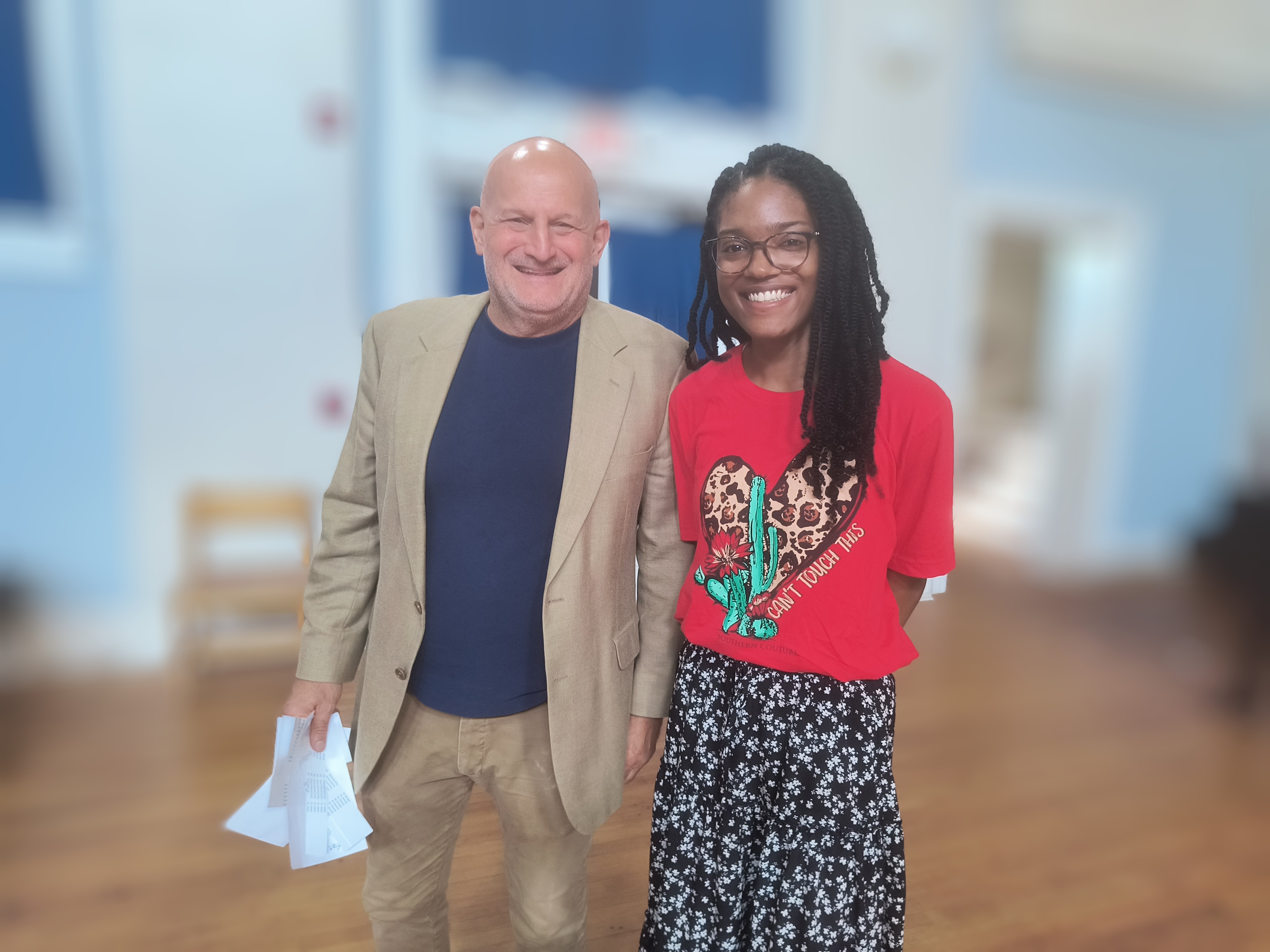
Sarah fell in love with SCAD on her last school trip. SCAD is an expensive college but she was able to get grants for a lot of the tuition/fees. Her start at SCAD was not totally smooth (she had broken her foot skateboarding!) but Sarah was soon painting, learning, and enjoying Savannah. She even got to go on a semester abroad to Lacoste, a small village in the south of France. Sarah has since held jobs with the Myrtle Beach Art Museum and the Atlanta High Museum. She had opened her own studio in a co-op in Atlanta with several “fellow creatives.”

“When you make plans, life makes other plans for you,” Sarah told us. The building where the co-op was got pulled from the market and Sarah found herself having to start all over again. She does her best to see obstacles as learning opportunities and ways to find out more about what she is capable of. She says to herself, “I will carry this with grace.”

Now Sarah has an even bigger studio here in Georgetown where she is preparing to open for business with a gallery and website. Her favorite medium is oil and her favorite subject is people, but after her rigorous training, she can do it all. We wish her all the best as she starts her new life and business!

November 29: Giany Guedjo

Just after Thanksgiving break on November 29, we were introduced to Giany Guedjo, our guest speaker for Open Forum. He is currently the executive director at Carolina Human Reinvestment, a non-profit organization that specializes in promoting healthy lifestyles for kids in Georgetown County. He is also a talented linguist and speaks over 10 different languages. When he was a recent immigrant to the US, he learned to speak English in one year and three months at his first job over here, making sandwiches at Subway.

Giany was born in Bénin, a French-speaking country in West Africa between Ghana and Nigeria. Before emigrating from Bénin to the United States with his wife, Giany overcame very difficult conditions to get an education in Africa. For example, at his university in Bénin there were 2500 students in some classes. “Students broke windows to get in and get a good seat,” he said. “There were only 100 books for all those students.” After graduating as valedictorian, he worked at an orphanage and taught farmers how to market crops. Fourteen years ago, his wife won the US Immigration Lottery and they decided to move here.

Life is not easy for immigrants and Giany and his wife were no exception. The job at Subway allowed them to survive until Giany could get enough English to go back to school. He then got a Masters of Business Administration from Webster University. Even then, it wasn’t easy to find work. Giany learned of the job at CHR almost by accident but it is a great fit for him and he is now the proud executive director of this community nonprofit in both Georgetown and Pawleys Island.

One of CHR’s projects is community gardening. There are gardens in Georgetown, Pawleys Island, and at several area schools. People from the community and students can take home fresh produce and eat healthier, better-tasting food.  “Food is medicine,” said Giany. CHR also sponsors comprehensive after-school programs where elementary students can do their homework and practice their reading. Giany invited us to come read with kids as community service. CHR also has helped older kids find after-school and summer jobs in the community and managed the FoodShare program to help food-insecure families.

Giany told us that you should have fun in life, but you should get your work done first. He has a particular philosophy to conquering life, which is “when you do something, do it the hard way.” This is accompanied by a list of four rules: sleep hard, eat hard, play hard, and most importantly work hard. We would like to thank Giany for being our guest speaker for Wednesday and giving us the opportunity to do more community service with the CHR.

By Larson

January 18, 2023: Kris Brame

Today, TGS said, “Bonjour!” to Kris Brame, Mme Gates’ former French student who also had Mrs. Patrick, Dr. Gates, and Dr. Neubauer as his high school teachers. Fluent in French and German, he now works as a translator today after starting his own company By The Word Translation. He talked to us about his love for learning languages and his international educational path.

Kris originally wanted to learn German, inspired by an Austrian exchange student his family hosted when he was in 8th grade. He told us “Everyone was always asking Fabian ‘How do you say that in German?’ and I learned the words.” He took French in high school, then decided to go on a German high school exchange program before graduating. While there, he began to perfect his German and French.

After earning the German equivalent of a high school diploma, Kris decided to stay in Europe to pursue translation studies at the university level in Mainz. He finished his B.S. at Kent State, then interned as a medical interpreter in Indianapolis.  COVID put an end to in-person medical interpretation and at that point, Kris took the big step of starting his own company.

By the Word Translation is Kris’s online enterprise. He is still a medical interpreter, but now mostly does subtitle translations for many clients, most notably Netflix and a French poker show. Unfortunately, Kris couldn’t give any spoilers for our favorite shows! He had some advice for students who wish seriously to master their foreign language: find a good friend who is a native speaker to talk to and use the internet to read and listen to the language you want to learn. Vielen Dank, Kris! 

By Emily

12/04 Dr. Andrea Bergstrom

Dr Andrea Bergstrom, a professor at Coastal Carolina University, came to speak to our school about social media.  She got her PhD in communications at the University of Massachusetts, Amherst in 2011.  Since then, she has been a researcher at CCU studying media and its effect on human behavior.  In the world of the internet, she warned students, there are three key points to remember: safety, privacy, and thinking critically.

Internet safety is more than just not meeting with strangers.  You should never give anyone your username or password, even if they’re your friend, because you never know what they could do with it.  “If somebody sends a mean message from your account, you can get in trouble for it.”  She warned students, sharing with them the story of a college student who was expelled after a friend used his account for nefarious purposes.  She also said that giving away any information about yourself- whether it’s your full name, your address, or even just a blurry picture- can lead to people tracking you down.  Even if you think you’re being careful, small clues can add up until someone knows exactly who you are and where you live.

Once you post something online, it never goes away.  “You don’t control your information anymore.” Dr Bergstrom explained.  “Even if you delete it, you never know who’s taken a screenshot.”  She warned students that their future depends on what they post online; from college admissions boards to potential employers, everyone has the power to do a background check.  As a general rule, she advised that “if you wouldn’t want your parents to see it, you shouldn’t post it.”

“Have you ever looked something up or liked a post, and then the next day you see an ad for that exact same thing?”  She asked the students, and almost everyone nodded.  “You’re like, ‘whoah, it’s magic!’  Nope, it’s capitalism.”  She explained how websites, such as Facebook and Instagram, can share your search history with potential advertisers.  If you buy something that’s been advertised to you, such as from a sponsored post, you never know who is benefiting from your money.  Despite her warnings, Dr Bergstrom acknowledged that the internet can be a very useful tool- so long as you’re careful.

By Ryleigh

11/13 – Judy Sweitzer

“We all have a gift to give,” said Mrs. Judy Sweitzer, who came to tell us about her recent mission trip to Guatemala.  Mrs. Sweitzer’s gift was spending two weeks helping with medical and dental problems in the small village of Zapato, an annual visit sponsored by her church, Pawleys Island Christian.

Mrs. Sweitzer told us that life in Guatemala is hard.  The country has seen explosive population growth—400% in the past fifty years.  About half of Guatemalans don’t have clean water and 57% live below the poverty line on $2 a day.  One in fifteen children dies before age five; children who survive most likely will not attend school, with the result that 60% of Guatemalans cannot read.

Mrs. Sweitzer and her team spend most of their time dealing with a stream of villagers who do not have access to dental care.  The dentists administered local anesthesia and pulled teeth; Mrs. Sweitzer sterilized instruments, applied fluoride to children’s teeth, and passed out toothbrushes, “Can you imagine if you had an infected tooth and the dentist was only around once in the fall?” she asked us.

The dental team had time to enjoy Guatemala’s rich culture and landscape.  Mrs. Sweitzer explained that Zapato is close to an active volcano called Fuego, which rumbled, sent up smoke, and even gushed some lava while they were there.  “It was pretty amazing,” she said.  Mrs. Sweitzer encouraged us to give of ourselves to help others.  “You will be more enriched by the experience than the people you give to,” she promised.

By Fisher