Today at Open Forum, we were pleased to welcome Sara Beth Freytag. She talked about her passion for nature and wildlife and how that passion has impacted her life. Sara Beth was born in Kentucky and has loved nature ever since she was a little girl. This love ended up guiding her academic interests. She attended the University of Kentucky where she earned a master’s in forestry. At that point, however, Sara Beth began to feel that the world of scientific research was not the right way for her to go, so she pivoted her focus towards education.
Now Sara Beth is the Coordinator of Children and Youth Education at Hobcaw Barony where her focus is teaching ecology (the study of relationships of organisms to their environment) through special programs and summer camps. Hobcaw Barony is a local historical property and research center dedicated to educating visitors about the history of the our area, as well as conducting research into wildlife, ecology, and forestry.
Sara Beth ended her visit by leading us outside to play a game called Bats and Moths. The game gave us an opportunity to learn about how bats navigate through echolocation. First, everyone stands in a big circle to represent a forest. Then, two people volunteer to represent moths and one person volunteers to play a bat. Similar to the game Marco Polo, the bat is blindfolded and has to use the sounds of the two moths clapping to figure out where they are and tag them.
Sara Beth’s presentation demonstrated how her interests led her into working a fulfilling career where she gets to do what she loves every day. She showed us how our own personal talents through passion and education can inspire the next generation.
On September 30th, we welcomed our speaker, Steve Williams, a journalist and local historian who researches and publishes on the rich history of our area. “Steve Williams,” said Dr. Gates, “brings things to light that would otherwise be left in the dark.” Mr. Williams introduced us to two heros—one who is honored and one who deserves honor: Florence Nightingale and Florence Williams.
Everyone has hear of Florence Nightingale, the “woman with the lamp” who improved care for the sick in the nineteenth century. She was born into a wealthy and leisured family but at age sixteen heard the voice of God telling her to help people. This extraordinary and intelligent person decided to be a nurse in a time when nursing was not even a profession. After getting as much medical training as she could, Florence was assigned to the military hospital in Scutari, Turkey, during the Crimean War.
This hospital was in terrible condition—rats everywhere, soldiers dying of disease and infection, insufficient beds. Florence Nightingale and her team of trained nurses immediately got to work, cleaning and organizing. She kept meticulous records, documenting the circumstances of each patient and each death. Improvements in the care and facilities led to improved outcomes for the soldiers. Under Florence Nightingale’s supervision, the soldiers’ death rate dropped from 42% to 2%. The soldiers called her the “lady with the lamp” because she would carry a small oil lamp while caring for them at all hours of the night.
Mr. Williams then introduced us to Florence Williams, who lived in Georgetown during the Depression and was also a nurse. Georgetown didn’t have a hospital at that time—if you were very sick, you had to be treated at McLeod Hospital in Florence.
God visited Florence Williams in a dream and told her there was great work for her. When the hospital she was working at closed, she came back to Georgetown and used the spare rooms in her in her large home on Duke Street to shelter the sick people of Georgetown. Her house had 25 beds, a surgery, and two wards. It stayed open until the 1950s, when Georgetown Memorial was built. Florence Williams deserves to be honored for her kindness and service to the people of Georgetown.
Mr. Williams was struck by similarities between Florence Williams and Florence Nightingale. They were both nurses, they both received a divine calling, they both helped people, they both defied social limitations, and they both embodied greatness. He closed by sharing his favorite Dr. King quote: “Anyone can be great; all you need is a heart full of love and a heart full of grace.”
We look forward to joining Mr. Steve Willliams when a historical marker is placed in front of the lot where Florence Williams’ house used to stand, to honor her memory and be inspired by her kindness.
What a pleasure to welcome back Qulex Dickerson, TGS Class of 2020! Qulex was a friend to all when he was here. He filled us in on how his life has been going since graduating from TGS.
Qulex graduated from Coastal Carolina University in 2024 with a degree in Graphic Design. Jobs in graphic design seemed to be scarce then, so he began working at the YMCA, educating kids and running the after-school program. Today, Qulex works for the non-profit Friendship Place in Georgetown.
Friendship Place aids families / neighbors in the community with programs such as Georgetown Eats, Georgetown Lives, Georgetown Prays, and Georgetown Learns. This organization helps move people “past crisis to self-sufficiency.” Qulex told us we could help at Friendship Place by volunteering to serve food. We can also contribute to the “blessing boxes,” which contain free soap, deodorant, and other personal items which people in our community may lack.
Qulex has good memories of Dr. Simmon’s classes (British and American Literature). He laughed when he recalled a project they all did on James Dickey’s novel Deliverance. “It was the only grade I got a 100 on!”
Qulex’s visit was a reminder that school doesn’t last forever. “Stay consistent,” he told us. “Stay focused.” It’s great to enjoy the success of a Kingfisher!
Andy Friedman spoke to us during Open Forum today. He is a financial adviser at Raymond James and a member of the Board of TGS. He talked about how starting to invest early is a good strategy for young people. He also revealed to us how to become a millionaire by the time we retire.
Mr. Friedman’s job is helping clients have enough money for a comfortable retirement. He told us that in South Carolina today, a person probably needs about $989,658 saved up to stop working. Of course, that number is for someone in today’s economy—not the economy in which our students will retire 50 years from now. Mr. Friedman explained how inflation devalues what people save (prices have risen on average 3% each year since 2006). Because of inflation, by the time current 15-year-olds are ready for retirement, they will need about $2.43 million. “That’s a lot of money,” Mr. Friedman said.
This sum is truly a ton of money, but Mr. Friedman explained that it is possible to acquire it. He told us how. Basically, young people must start early and invest regularly and consistently in the stock market. The money will grow more and more easily over the years, due to the “magic” of compound interest. He told us to think of pushing a snowball down a hill—a snowball is hard to get started but as it grows it will start to roll by itself. The money you invest gets increasing returns year over year if you leave it alone.
“Compound interest is considered the eighth wonder of the world,” Mr. Friedman said. “But time is the key.” He gave us a concrete example: if a person had put in $100 in the 1976 market and had added $100/month until 2026, they would have approximately $2.3 million, a very comfortable retirement. He supported this claim with statistics about how the market has performed since 1976—some years it has earned up to 37% returns on investments.
“Waiting will cost you more,” Mr. Friedman told us. “Start early, invest every month, use employer plans, and raise contributions.” Thank you, Mr. Friedman, for your wise advice!
Nobody would ever suspect that our teacher Mrs. Porcher Scott has a rare blood disorder by just looking at her, but she does and it is serious. She raised our awareness of her “invisible disease” today at Open Forum.
In 2003, Mrs. Scott was diagnosed with a condition called ITP (immune thrombocytopenia). ITP is an uncommon blood disorder where a person’s blood has a low or extremely low platelet count. (Platelets are fragments of blood cells that are crucial to the immune system because they form blood clots to help prevent bleeding.) The average person has 150,000 to 450,000 per microliter, but Mrs. Scott has less than 50,000 per microliter. This means that if she got hurt, she could be sent to the hospital for a serious emergency involving internal bleeding.
After being diagnosed, Mrs. Scott was limited to a number of things she could and could not do. “I was scared I would have to live in a bubble,” she said. “How would I live my life?” She had to give up most sports. She is also not allowed to scuba dive or ride roller coasters because of the extreme pressure changes. Mrs. Scott tried multiple different treatments including having her spleen removed. The operation ultimately did not do her any good. “Now I’m one down on my immune system,” she told us.
Sadly, there is no cure for ITP, and doctors can not even explain the cause of ITP. For a long time Mrs. Scott felt alone, isolated. “I thought I was the only person who had it,” she told us. Then she discovered the Platelet Disorder Support Association.
Founded in 1998, the PDSA boosts the lives of people with ITP by raising awareness and educating the public about immune thrombocytopenia and various other platelet illnesses. Mrs. Scott now has her own community whom she can relate to and share her story with. She has been active in the leadership of the PDSA for 16 years, working tirelessly to improve the lives of people with ITP.
To show our solidarity with Mrs. Scott, we are all invited to wear purple on September 25, which is “ITP Awareness Day.”
By Sydney S., photoscourtesy of Marsh Deane, MLNL Media
Award-winning actor Bill Oberst held us in thrall today at Open Forum, treating us to a performance that gave us just a taste of his incredible acting ability.
Bill performed his own story, the story of a struggling 14-year-old boy who suddenly found his place in the world when he discovered the writings of Ray Bradbury. Right in front of us, Bill Oberst turned into his teenage self, riding his bike through Georgetown out to the canal. Filled with hatred, trying to escape the world that was suffocating him, he came across a book on the ground. The tattered, muddy paperback was S is for Space, a book of short stories by Ray Bradbury. The angry teenager opened the book to “Pillar of Fire” and read these words: “He came out of the earth, hating. Hate was his father; hate was his mother.”
Bill kept reading and immediately connected with the character in the book. “Because my pain, my shame were named,” he said, “I didn’t have to carry them anymore.” Bradbury’s writing had literally saved him. “These sentences are the reason I’m standing in front of you,” he said. For Bill, discovering good writing was finding out that he was not alone in the world. Bradbury’s writing allowed Bill to see himself and his flaws in the characters this writer created. Bill urged us to fall in love with language for the sake of our humanity. When we read a great writer, the gap that separates us from each other is bridged.
Bill the angry teenage grew up to be an awesome actor. He has done over 200 films and various TV projects where he is nationally known for portraying dark, complex characters. (His most recognizable role is one of the most notorious criminals in CBS’ hit series Criminal Minds.) Bill has also created one-man stagings of characters such as Jesus of Nazareth, Mark Twain, Ray Bradbury, Lewis Grizzard, and most recently, Satan the Adversary.
Bill’s message to us today was about the importance of language and writing as a channel to our shared authentic humanity. “Fall in love with language,” he told us. “That is a love that will never end.”
Being able to think and talk about both sides of a controversial issue as objectively as possible is an important skill for any citizen. When people can’t engage in civil discourse, there is no exchange of ideas. That’s why senior speeches are a graduation requirement at TGS. Our seniors must prepare a short talk about an issue, then deliver it to faculty, friends, and family in order to receive their diplomas. After the speech, they must also answer questions from people in the audience. Senior Speech Day is a major milestone towards proving that seniors are ready to go out into the world.
Our assembly began on a very high note, when Dr. Gates passed out TGS rings to all the seniors. These rings are a gift from Sonny and Lori Burgoon of Diamond Collection who want to honor all the graduates with a lasting and beautiful memento of their years at The Georgetown School. Thank you so much!
Then, the Class of 2026 did a great job presenting and defending their positions on a variety of issues.
Baryck Jackson heads to U. S. C. this fall. He argued that companies are overstepping their bounds by installing overly complicated electronics in cars and farm equipment. Given the difficulty of finding and training qualified technicians, these electronics place an undue financial burden on the owner when things go wrong. The reputation of the company suffers when it can’t keep its machinery running. Some (John Deere) are being sued by angry customers. Companies are doing a disservice to their customers and themselves through over-use of complicated electronic systems.
Bryan Amerson will also study at U. S. C. Bryan took on the topic of AI, arguing that its use should be limited to small and specific applications, such as in medicine. The way AI acquires data from unconsenting people is leading to a massive invasion of privacy. Biometric data has already been stolen and sold after data breaches; it is time for the government to reign in and narrowly define the uses of AI.
Hannah Bridges will attend Horry-Georgetown Technical College. She argued that social media is dangerous to children under 15 because their brains are still developing and there is too much noxious material that can influence them for the worse, even driving them to suicide. She said it was the social media companies’ responsibility to keep minors away from inappropriate content.
Larson Lee is heading to the College of Charleston. He believes that the energy future of America lies in developing low-cost and safe nuclear plants. Unlike other fuels, nuclear is relatively clean and can be obtained domestically, reducing both pollution and our dependence on foreign sources of energy. Larson noted that very safe methods of either disposing of or reprocessing spent fuel rods already exist. He maintained that disasters such as Three Mile Island and Chernobyl were due to mismanagement of sites, not nuclear energy itself.
Noah Miller is attending Horry-Georgetown Technical College this fall. He spoke from his experience as a home-schooled student and argued that traditional (whether public or private) schools do a better job of producing well-educated, well-adjusted graduates. Homeschoolers often do not have adequate time for socializing with their peers, and the longer they are home-schooled, the more difficult their classes become and the more they will need certified teachers to educate them.
Gracin Farwell will go to Wingate College next fall. Gracin’s topic was surveillance overreach through technologies such as the Flock Safety camera. The Flock scans license plates and creates a huge data set of pervasive, long-term tracking of people’s movements. Many see this as a search without a warrant and an invasion of the privacy guaranteed by the 4th Amendment. Gracin believes that surveillance technology should be used to pursue criminals (all proper legal channels being followed) but must be severely curtailed in the case of private citizens going about their business.
Corrin Anderson is accepted at Southern New Hampshire University. He argued that the words of our national anthem, “The Star-Spangled Banner,” should be updated. The words, he said, are difficult to memorize and many citizens do not really know them well enough to sing. The verses refer to the War of 1812 and many people find them archaic and overly militaristic. Corrin argued that warlike lyrics are not relevant and should be replaced by words which reflect the values of modern Americans: freedom, equality, progress.
Kipper Saliaris will attend Lander College this fall. Kipper argued that there are too many hormones in the foods we buy at the grocery store. He explained that there are mainly two types of hormones in use: growth hormones to promote bigger animals and hormones that are sprayed on food when it is harvested to keep it fresh longer. These hormones are harmful: there are studies that point to an increased chance of slow metabolism and gynacomastia in children. Kipper pointed out that such hormones are already banned in many parts of Europe and should be banned in the U. S. In the meantime, he recommends buying organic food and preserving it by freezing, canning, or drying.
The faculty will choose one senior to receive the Senior Speech Award at Awards Day.
Photos: courtesy of Marsh Deane (MLNL Media), Nolan, and Christine Anderson
Every year in the spring, Kingfishers go on a school-wide trip to an unknown destination. This year, we went west to Tennessee. Our bus driver, Ms. Sherry, picked us up at school around 8:00 on March 3. After good-byes and phone collection, we were on our way! The first point of interest was the town of Kingstree, where Richard got to see the train station, but (sadly) no train. For our first lunch, we brought bagged lunches into a Hardees south of Columbia, where kids could order drinks or dessert and visit the convenience store next door.
After many hours on the bus ride heading west on the interstate, we finally got off onto smaller roads and arrived at Roan State Park, just over the border in Tennessee. We were all eager to check out our cabins, the area, and to simply get out of the bus. As we stepped out, we were in awe of the towering pine trees, rugged landscape, and picturesque cabins situated on a hilly horseshoe road surrounded by the woods. We grabbed our luggage and toiled up the steep hill to our cabins, which were clean and spacious. They had A/C as well!
Just as we began to settle in, we were all informed that we would all have to meet back up at the bus, ready for a hike. Everybody was a bit drowsy from the bus ride, so we needed a good way to stretch our legs and wake ourselves up. What better way than to climb a mountain? Before boarding, the teachers divided everyone into four groups: the Chickens, the Horses, the Rabbits, and the Snakes. Each group had to find its members by silently doing its animal’s “dance.” Next, we re-boarded the bus by groups and took a quick trip to Carver’s Gap (elevation 5512 feet).
Up here, it was 20° colder, with 30 mph wind gusts. Everybody got out of the bus and began to hike up the path, slowly making their way up the slope covered in a layer of grass akin to that of a hay field. As we ascended, we soon entered a forest filled with a vast amount of spruce trees, blocking out the wind we had previously been facing. The trees also shielded us and some small patches of snow from the sunlight. As we got close to the peak of our hike, we exited the forest and came to a large rock on the slope. Many of us climbed on top of it, to better appreciate the beautiful view of the mountain range and the sun as it began to dip down behind the horizon. When the sun finally disappeared, we realized it was time to go, so we all took our final looks, returning back down the trail to our bus. Soon we were back at the cabins, ready for our dinner of hamburgers and potato salad.
Roan State Park was really nice. Each cabin had two beds upstairs, a couch, and a suite room for the teacher. One cabin ended up with six high school boys. “We spent much of our down time playing card games and hide-and-seek,” Reece said. Their favorite day was when they got to make ramen with leftovers and “pie” from a “prison” recipe. The middle-schoolers spent evenings outside searching for monsters they called “skinwalkers.” High-schoolers joined in to scare them. The stars were amazing in all that darkness.
The next day, we were back in the bus early so we could drive to Oak Ridge, a town outside of Knoxville. There, we visited The American Museum of Science and Energy (AMSE). This museum, located in a strip mall, is dedicated to showing the vital importance of science and engineering in our past, present and future. Before we were let loose to explore the museum, our knowledgeable docent led us into a conference room to show us a very “shocking” device. The device she pulled out of a broom closet was a vintage Van der Graaf generator, used to create static electricity on a large scale. She demonstrated its power: with one hand on the machine, she lit up fluorescent bulbs in the ceiling by gesturing at them. The most exciting part was when she had us put our hand on the dome of the device and the static electricity caused any hair we had to stand up. This wonderful machine even caused Dr. Gates’s arm hair to frizz and Jamie’s braids to curl up at the ends. You can see from the photo of Elizabeth how surprising the experience was!
When we showed up at Chik-Fil-A for lunch, we were greeted with a nasty surprise: the Oak Ridge warning siren began blasting and continued for three solid minutes. It turns out that the local emergency alert system is tested on the first Wednesday of every month! We were “lucky” to experience this aspect of local culture.
After Chik-Fil-A, we went to the Ice Chalet, a skating rink in Knoxville. Ice skating has become a tradition after last year’s unforgettable experience in Williamsburg. This rink was a lot nicer, with some really talented skaters zipping around. Energy filled us as soon as we stepped inside, the cold air buzzing with our excitement and anticipation.
Students took to the ice, creating a scene that was both chaotic and joyful. Some wobbled along the edge of the rink before inevitably slipping and falling, only to burst into laughter as their friends tried to help them back up. A few high-schoolers showed off, or at least attempted to, spinning, racing, and joking around with a confidence that didn’t always match their balance. Despite the falls, the atmosphere remained lighthearted and full of fun.
On the third day of our trip, we took another long but lively bus ride to the University of Tennessee in downtown Knoxville. UT is a massive campus, home to more than 30,000 students. Stepping off the bus, we could immediately feel the school spirit and energy of a place that never really slows down. We kicked things off with a guided tour led by Kate and Haylee, who brought the campus to life with their enthusiasm and inside knowledge. As we walked, we got to see both the official mascot (the Torchbearer) and unofficial mascot (Smokey the Bluetick Coonhound) that represent the school’s spirit, along with some of the most impressive parts of campus, including their state-of-the-art nursing building and the enormous stadium that stands as a symbol of school pride.
As the tour continued, we made our way to one of the most iconic traditions on campus, the Rock. This massive boulder serves as a creative outlet for students, who cover it in layers of paint to share messages, promote upcoming events, and even advertise sign-ups for clubs and activities. It’s constantly changing, a colorful reflection of student life. Our guides told us a wild story about how, after an anonymous student once painted a coach’s phone number on the Rock following a controversial decision, the university had to install 24-hour surveillance to keep things under control. Moments like that made it clear just how passionate, and even sometimes unpredictable the student body can be.
By the end of the tour, the heat and the walking had definitely caught up to us, so stopping at the main dining hall, Rocky Top, was the perfect idea. The two-story cafeteria was huge, filled with a wide variety of food options that seemed to go on forever. From quick snacks to full meals, there was something for everyone. We had a chance to relax, refuel, and take in everything we had just experienced.
Overall, visiting the University of Tennessee wasn’t just a campus tour, it was an inside look at a vibrant college community full of tradition, energy, and personality. It left many of us imagining what it might be like to one day be part of a place like that when we graduate.
Our meal at the Rocky Top Dining Hall was very satisfying but there was no time for a nap. The bus took us to Navitat Recreation Center, an outdoor paradise with gardens, walking trails, and a ziplining course! We immediately forgot our full stomachs and got geared up in harnesses and helmets, ready for adventure. After a little training in how to stay safe by some very patient guides, we started out on different levels of high ropes. The group was really stoked and got out on the ropes 40 feet in the air as fast as possible. “I really liked all of the different ropes courses,” Nolan said. “My favorite course was Treason, the hardest one. It definitely tested my upper body strength.”
The last formal meal we had on this year’s school trip was at Freddy’s Steak Burgers. This restaurant really is few eateries back in Georgetown because the interior was a 1960’s diner featuring crimson red booths, black and white checkerboard pattern floors, and a friendly staff. Students were very happy to stretch their legs and enjoy some custard and burgers while resting in the booths.
The ride home from our atomic adventures in Tennessee was pleasant and bittersweet at the same time. We got up bright and early to pack our things, clean the cabins, and make sure we didn’t forget anything before boarding the bus. We were very grateful to our bus driver Sherry for driving us this year and we all thanked her for her excellent driving. On the bus, there was plenty of excitement as many high and middle school students played games and ranted about everything that happened on the trip. Some were too tuckered out, though. “With how much we did on the trip,” said one high-schooler, “I slept the whole way home.” The student chatter went away when we passed Columbia because Dr. Gates handed out our phones. This trip to Tennessee was exciting for the new students on their first school trip. It was also bittersweet for the seniors on their last one. We will not be forgetting the adventures we had in Tennessee anytime soon!
By Eleanor, Larson, Nolan, Reece, Caleb and Hannah
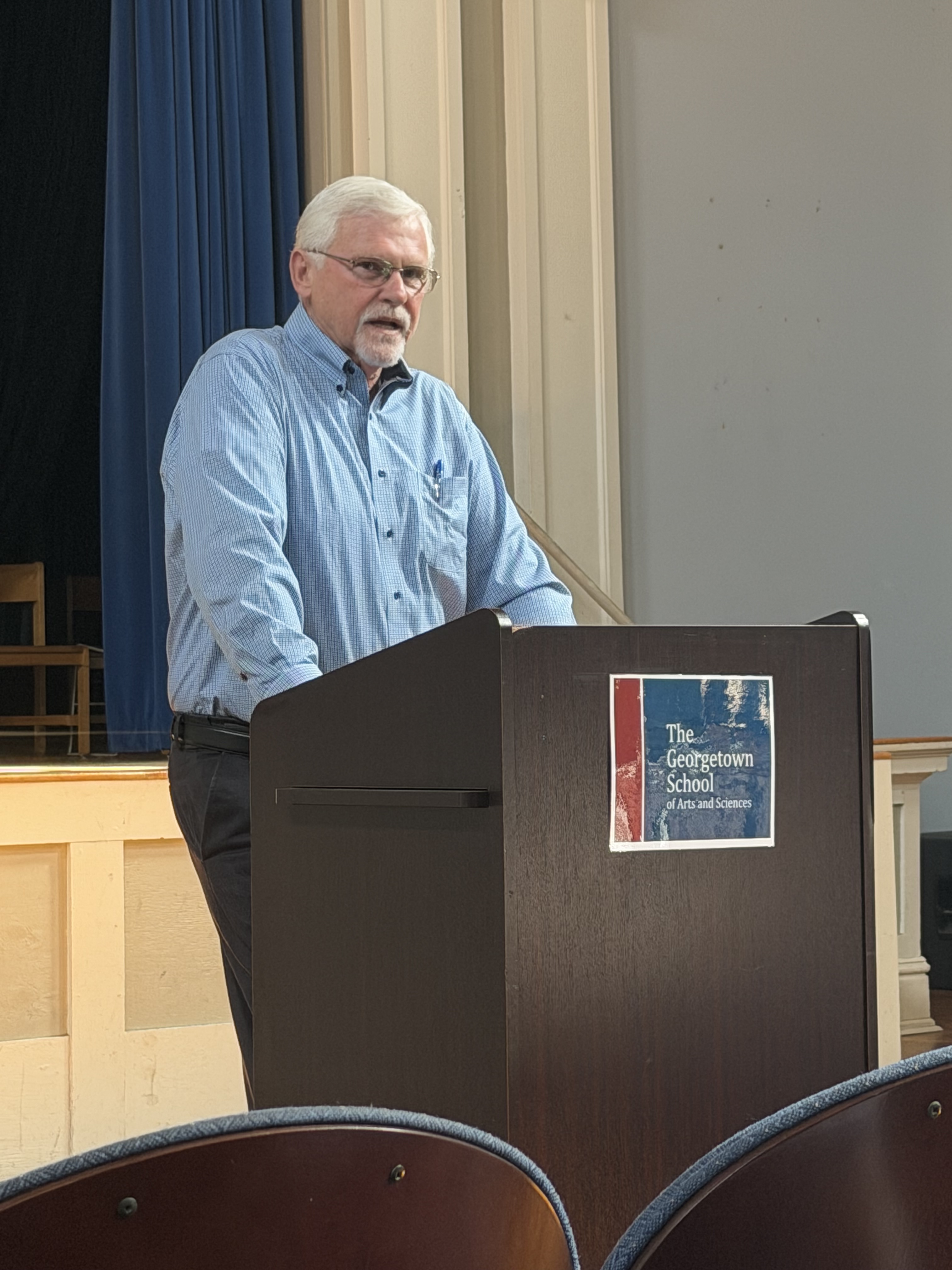
Our guest today was Georgetown’s new mayor Jay Doyle. He is the first third-party candidate to be elected to this position since 1894. Mayor Doyle has been a Georgetown resident for sixteen years. He grew up in Massachusetts and attended Northeastern, but left in order to become an entrepreneur. Over the years, he owned a successful construction and energy-saving company, worked in telecommunications, and also served Brookgreen Gardens as Director of Facilities.
Mayor Doyle spoke to us about the importance of learning. “I’m sixty-eight years old and I’m still learning,” he said. “Learning is something that will stick with you throughout life.” He also pointed out the possibilities and dangers of information people obtain from the internet. “I can go online to figure out how to fix something,” he told us, “ and I can go online to learn how to hate someone.”
Mayor Doyle explained how his goals are to preserve Georgetown’s historical aspects, protect the surrounding woodlands while rezoning, and to provide employment for citizens (especially those impacted by our two mills’ closing). “Urban planning is a huge part of what I’m accomplishing,” he said while discussing his focus on development and where to construct new establishments. He invited students to contribute to his plan by coming up with their own ideas and plans for open areas in Georgetown.
Thank you, Mayor Doyle, for taking time to introduce yourself to us!
On Wednesday, March 1, the whole high school drove to Charleston to see Tennessee Williams’ play The Glass Menagerie at the Dock Street Theatre, presented by Charleston Stage.
We arrived early enough to get in a visit to the Fireproof Building, which houses the South Carolina Historical Society Museum. There were all sorts of cool exhibits, including a home movie of people harvesting rice made in the 1930s. They were using 18th and 19th century techniques brought to the New World by enslaved people. Isaac really liked the flintlock exhibit and all the boys thought the display of different “sands” that were spewed out from the earth during the Charleston Earthquake of 1886 were very interesting. Mme Gates saw a quote by a South Carolina attorney general on a tee shirt that was pretty funny: “South Carolina is too small for a republic and too large for an insane asylum” (James Louis Petigru).
We walked to the Dock Street Theatre and arrived in plenty of time for the play. Soon were were drawn into the “fragile world of the Wingfield family, where dreams and reality intertwine in a tender dance” (Charleston Stage). Many of the high school students had read the play with Dr. Simmons and everyone thought the production was really well done. The play was cut significantly but all the drama was still there. “The shortened ending suited just fine,” said Morgan.
Lunch was a quick stop at Chik-Fil-A. Gracin and his table were able to use the hot sauce he had bought at the Fireproof Building on their sandwiches (yum!). We managed to get back to Georgetown shortly after 3:00. Thank you, Dr. Simmons, for planning this great experience.




You must be logged in to post a comment.