Sixth and seventh grade Language Arts students assembled on the front lawn to perform the death scene from Shakespeare’s Julius Caesar. The senators dressed in togas and carried various fake swords and knives. As each senator stabbed Caesar (J’Marion), he or she tossed a small cup of real fake blood onto his toga. But somehow a little blood got onto other people’s togas.
Other main actors in the outdoor performance included Brutus (Morgan), Marc Anthony (Camper), and Cassius (Trey). Casca (Annika) got to stab Caesar first.
The
next day, Mrs. Crosby was despairing of her bed sheets. “I got most of the blood out,” she said. “But one toga is still soaking.”
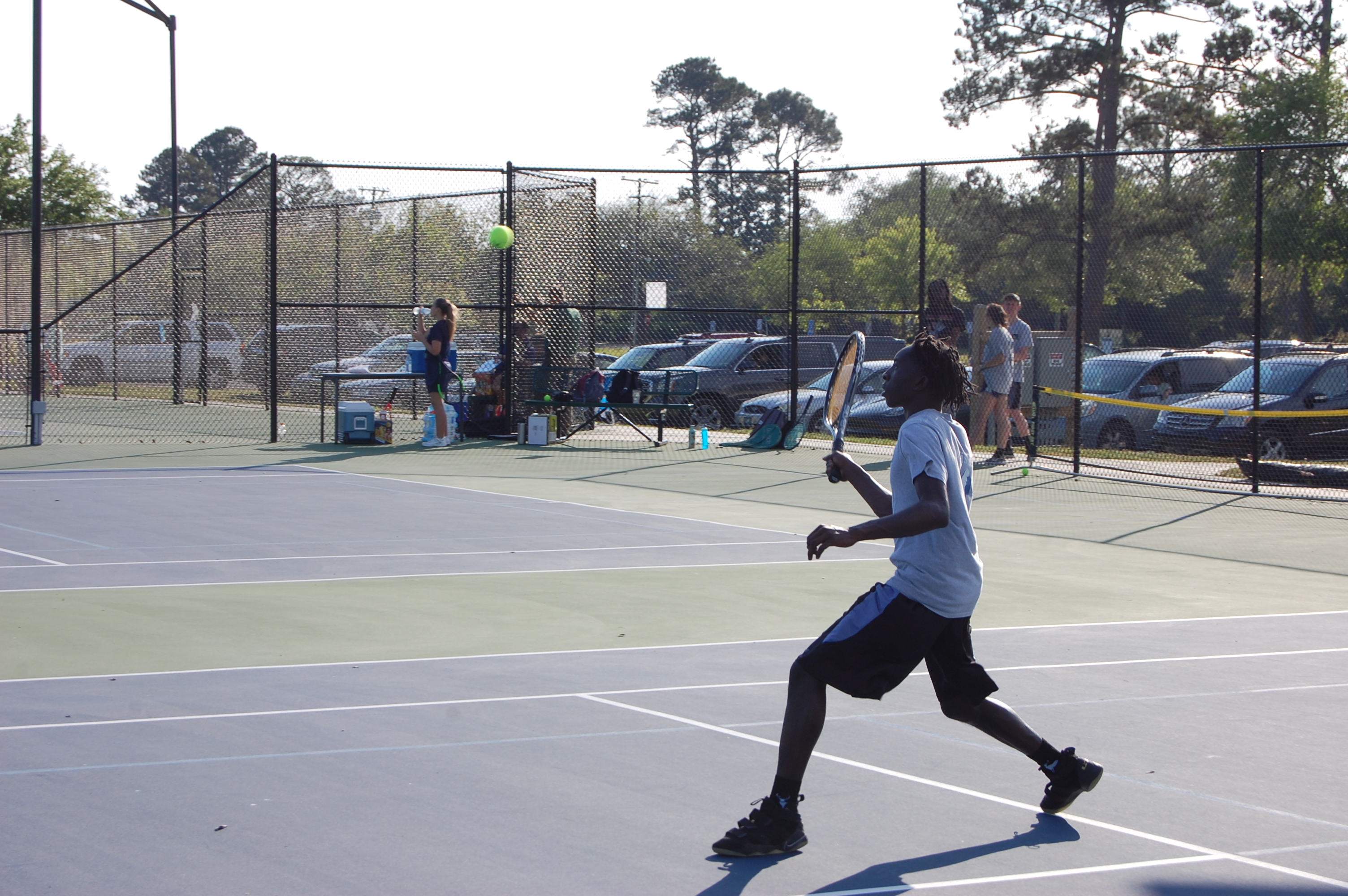
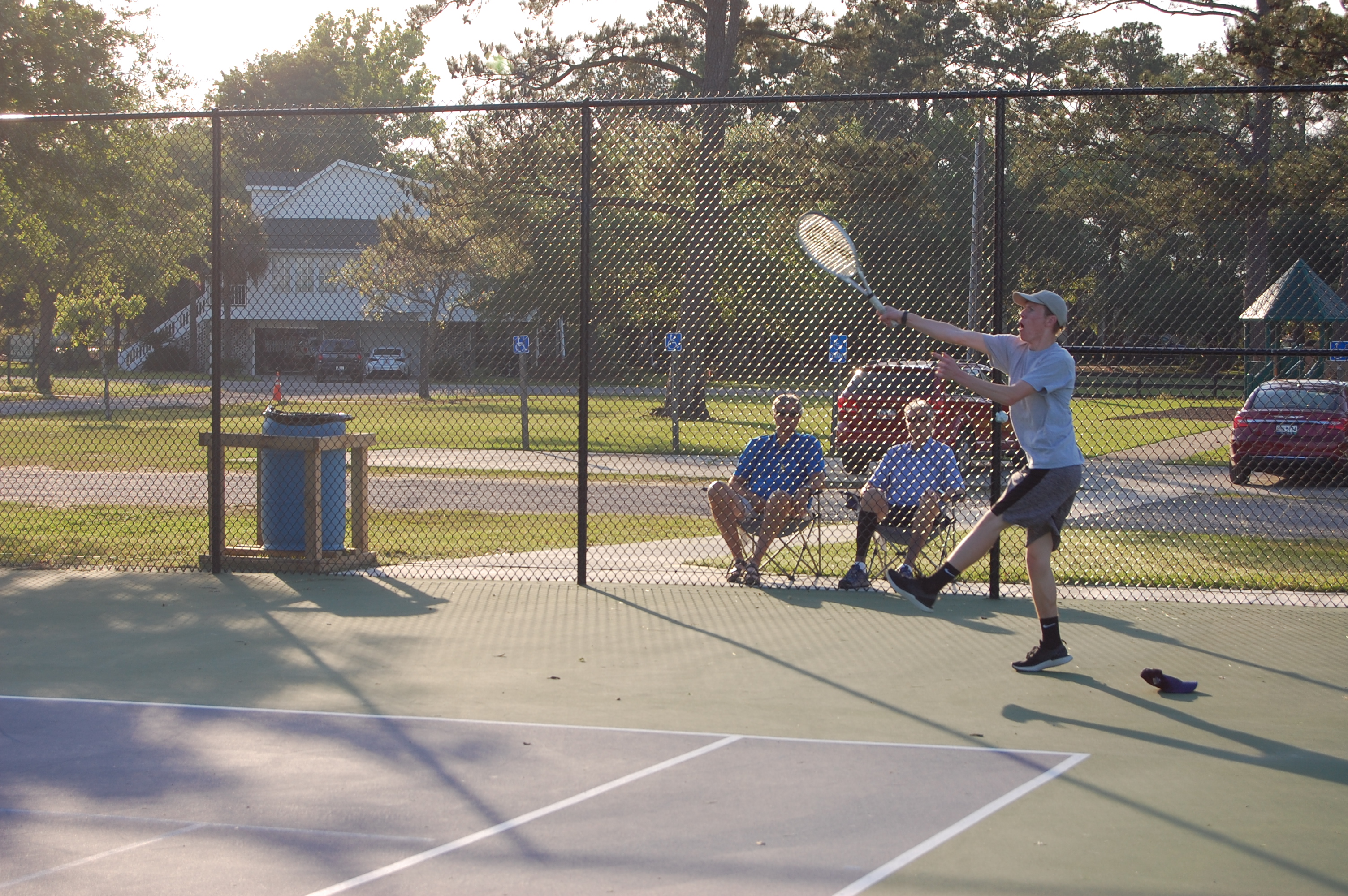
TGS had a competitive boys’ tennis team this spring which included several girls. Coached by Dr. Gates, the team practiced in the afternoons down on the brand-new courts at East Bay Park and the West End courts. They played a total of four matches against Elizabeth Anne Seton Academy (Myrtle Beach) and Palmetto Christian Academy (Charleston).
“It was a great season,” said Coach Gates. “Everyone improved tremendously and almost everyone eventually won a match. Our two seniors Grayson and Zachary won their final doubles match, which was really nice.”
Although the team did not win any tournies overall, the season was a valuable learning experience for the Kingfishers. Four team members had never played tennis competitively before, including Qulex, who won his final match.
Grayson, Zachary, and Naomi were named to the SCISA All-Region Team.
Qulex and Margaret planned a senior night for the team after the final match against EAS on April 25. “Qulex delivered a beautiful speech about how we are teammates and brothers,” said Zachary. “I almost got tears in my eyes.” He and Grayson, the two senior honorees, received baskets of candy with a tennis theme.
2019 TGS Tennis Team players included Jesse Deluca, Qulex Dickerson, Naomi Higgins, Manny Marcantoni, Rebecca Kaminski, Grayson Sossamon, and Zachary Wesolowski.
On
Friday, April 12th, Dr. Laura Gates, Mr. Bonds, and Dr. Simmons took the
American History students on a trip to visit the islands that make up the Tom
Yawkey Wildlife Center, located about twelve miles south of Georgetown. This
area is a real treasure trove of undeveloped land– teeming with wildlife, and
brimming over with history that is just now starting to be understood.
Armed
with rain gear, bug spray, lunches and water, students and teachers got caught
in a sudden shower as they were awaiting the boat to cross over to Cat Island. No one’s spirits were dampened, though,
because soon our host, Education and Outreach Coordinator Jim Lee arrived with
the boat to welcome us and ferry us over.
Jim
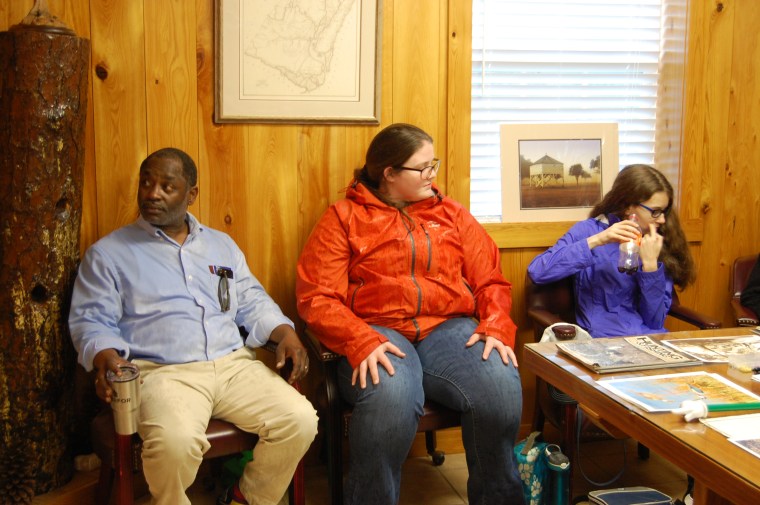
Lee gave us an overview of the property and how it has changed over the years,
using two aerial maps which were made about 80 years apart. He explained that offshore currents, weather
phenomena such as hurricanes, and the existence of the Jetties have caused the
striking differences in the shape/elevation of the islands. Jim Lee also took time to learn our names and
to find out what we were interested in seeing.
Most people were curious about the history but several wanted to see
wildlife. “I hope I can see a bobcat,”
said Grayson. Others expressed interest
in the roseate spoonbills and buntings.
Jamie Dozier, manager of the Yawkey Center, came in to greet us and to say that he was keeping a close eye on the radar because more rain showers were predicted. We found out that Jim Lee would be our driver and guide. Everyone got on the mini-bus with him to explore different areas of historical interest on the 24,000-acre property. It was an all-day proposition and we barely scratched the surface.
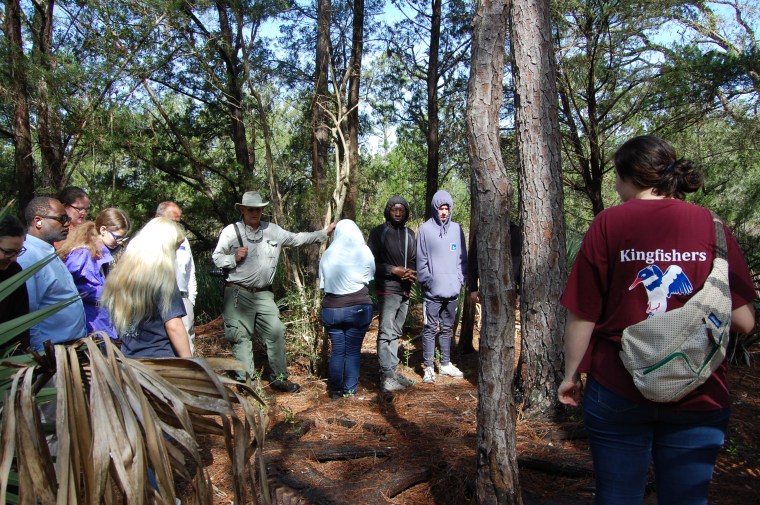
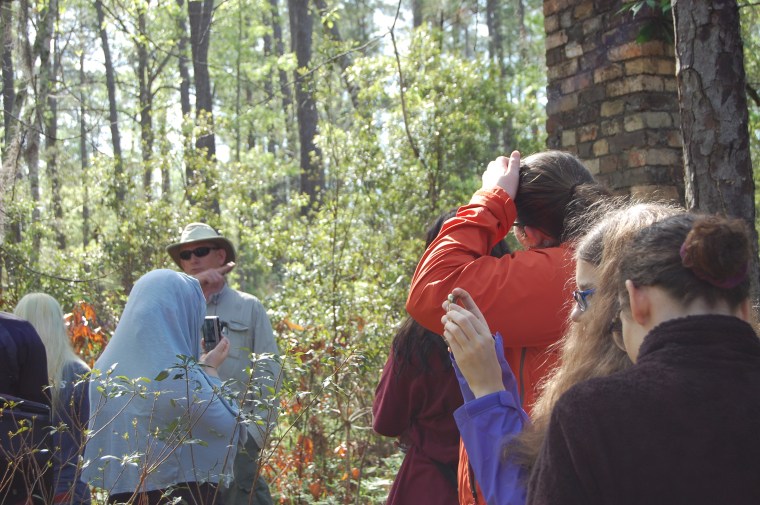
Because few of these areas are accessible by vehicle, students and teachers would disembark and walk to sites of interest. We reached the first historical site after walking through beautiful ferns for about half a mile. “Smithfield” is the long-abandoned site of a former sawmill and base of operations for the Army Corps of Engineers. Students photographed rusted heavy equipment used to move logs out of the ICW site and mill them. They also poked their heads and yelled into a concrete cistern which used to trap water for the steam engines.
Next, we went on to the Cat Island earthworks, the site of forts
during the Revolutionary War and the War of 1812, and most recently during the
Civil War. These were huge mounds of dirt created by enslaved people which are covered
in vegetation now. The view over Winyah
Bay was stunning. TGS students were
treated to a walk through and on top of the massive earthworks as Jim Lee read
from letters written in 1861 by a soldier named John Beaty who was stationed at
the fort.
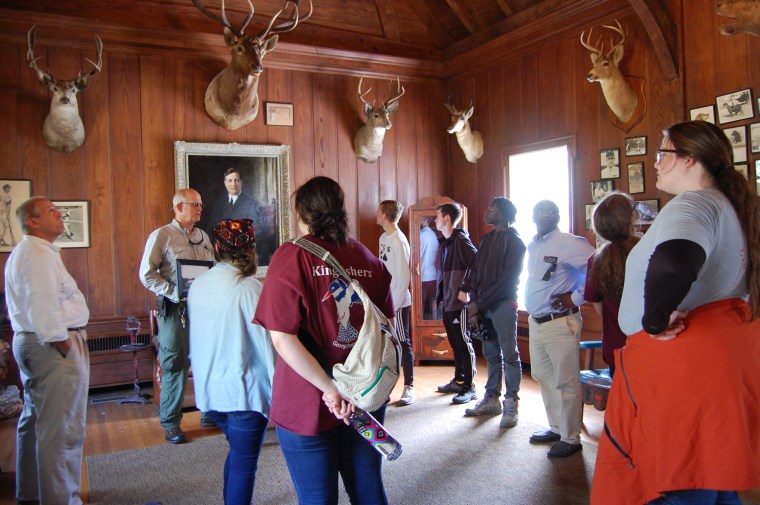
The group later visited the site of Tom Yawkey’s former residence
and “playhouse,” a building filled with memorabilia from the Yawkey’s
lives and adventures, as well as mementoes of his days as owner of the Boston
Red Sox. Tom Yawkey was an incredible
philanthropist (his foundation gave away $500,000,000 last year to various
charities in Boston and Georgetown; it pays the costs of keeping the Yawkey
Center open). “Tom Yawkey’s motto was
simple,” said Jim Lee. “’Do good, be
quiet, and don’t expect thanks.’”
TGS students ended the day with a visit to the South Island beach, across the bay from the North Island lighthouse. Some students skipped shells into the wavelets, while others sat on a palmetto log to chat some more with Jim Lee, who told us he would be happy to take us anywhere on the property in the future. On our way back to the boat, Jim Lee emphasized that Tom Yawkey intended his center to be used for three purposes: conservation, research, and education. We are eager to be a part of that.
TGS faculty and students are already planning a boat excursion to North Island next fall, as well as another trip to South Island in the spring. As Jamie Dozier, manager of the Yawkey Center said, we have probably seen less that 10% of the sites of historic interest located on the property. Without a doubt, these trips will remain a regular part of our experiential learning at TGS! And we still have to see that bobcat!






 The Georgetown School
You must be logged in to post a comment.