On April 17, 2024, Kaya Clavier, an Admissions Scholar from the University of South Carolina, visited our high school. Kaya actually went to USC herself. “I interned at the admissions center before graduation.” Kaya told us. She addressed us on the topic of college life and the application process for USC. She also distributed pamphlets that highlighted the experience of studying at USC.
The University of South Carolina offers a plethora of exciting activities for students to indulge in around its sprawling campus. “From enjoying a peaceful picnic to kayaking and canoeing, there’s no shortage of thrilling experiences to be had,” Kaya said. “Columbia is the perfect place for both urban enthusiasts and adventure seekers.” In fact, WalletHub has recognized this vibrant city as one of the top ten destinations in the country to kick-start a career. The University of South Carolina provides over 100 majors, ensuring that you can discover a field of study that resonates with you. Additionally, their honors college offers close to 600 courses, and there’s the Capstone Scholars program, which runs a two-year academic enrichment program. You can even participate in a study abroad program!
A big part of USC life is the sporting events. Kaya told us that as a student you will be able to get free tickets to games, as long as you register for them ahead of time. They have many different sporting and outdoor activities such as football, baseball, basketball, golf, and much more! “There is bound to be something for everyone at USC.” Kaya said.
Thank you so much Kaya for visiting our school and telling us about the University of South Carolina. Go Gamecocks!
On April 16, 2024 some Science classes got to listen in on Jason Flynn’s presentation to the Friends of the Library. Jason is a Horticulturist at Brookgreen Gardens with an interest in ecology, the environment, and most importantly, geology.
Growing up in northern South Carolina, Jason had access to geological deposits and plenty of interesting rocks to examine. He now works at the magnificent Brookgreen Gardens. But the Earth itself is a garden, Jason told us, and we should do our best to study and preserve it. Only 18% is left untouched by human hands, a consequence of human activities. We were very surprised to find out that our bodies are technically made from stardust, recycled into different objects over the course of 4.5-4.6 billion years.
Jason brought a variety of different rocks to accompany his talk. The most interesting was the SC state rock, Winnsboro blue granite. (Fun fact: it was used in construction projects in the capital in Washington D.C.) Jason later said that one of the reasons for geologic diversity and why we have the rocks we do in South Carolina is the shifting of the continents. His overall message was that we need to preserve our planet before it is too late.
Jason Flynn was a very passionate speaker who had a deep understanding of the geology of South Carolina. We would like to thank him for giving us a wonderful presentation on geology and the environment and also thank to the Friends of the Library for inviting us!
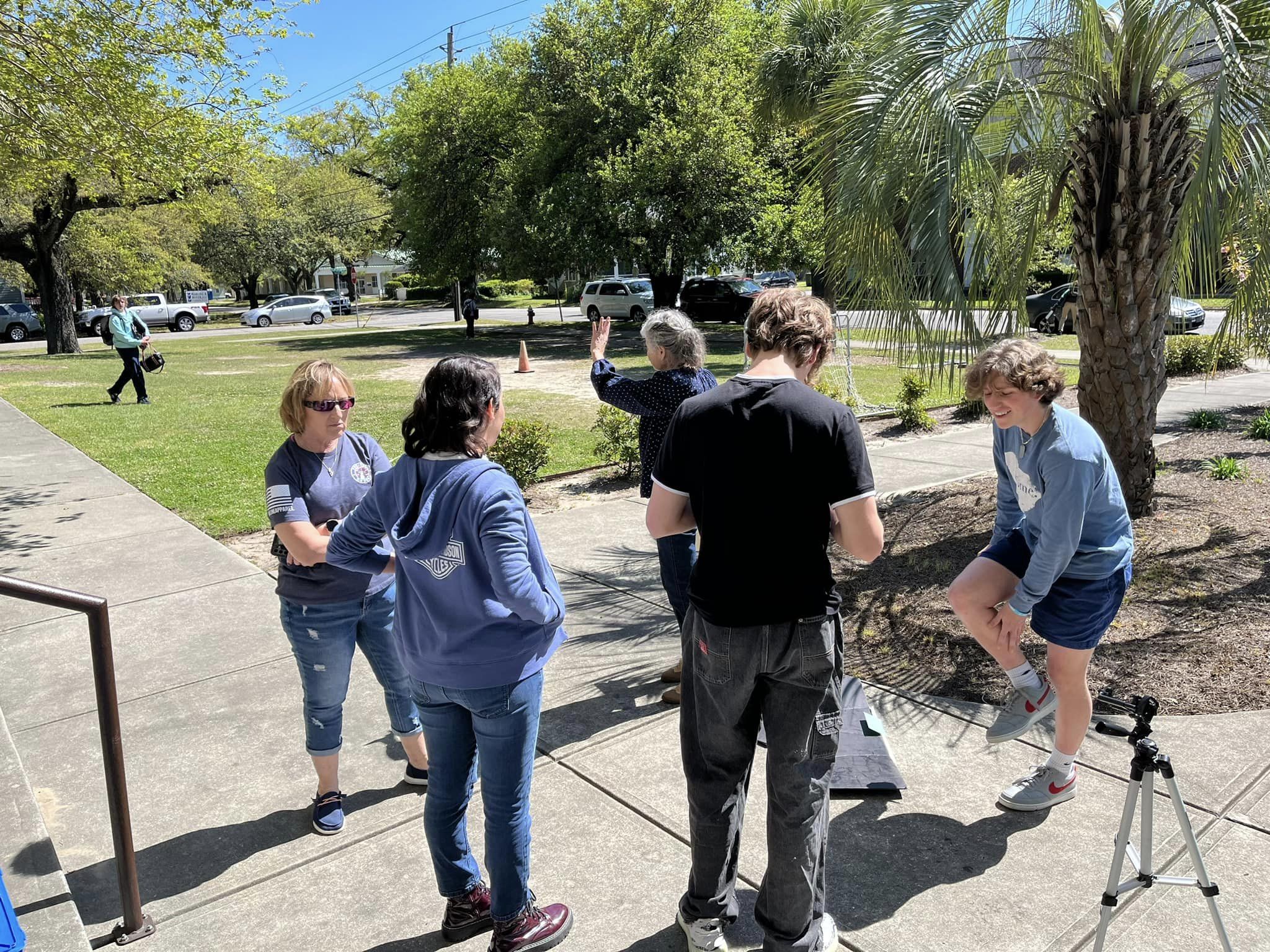
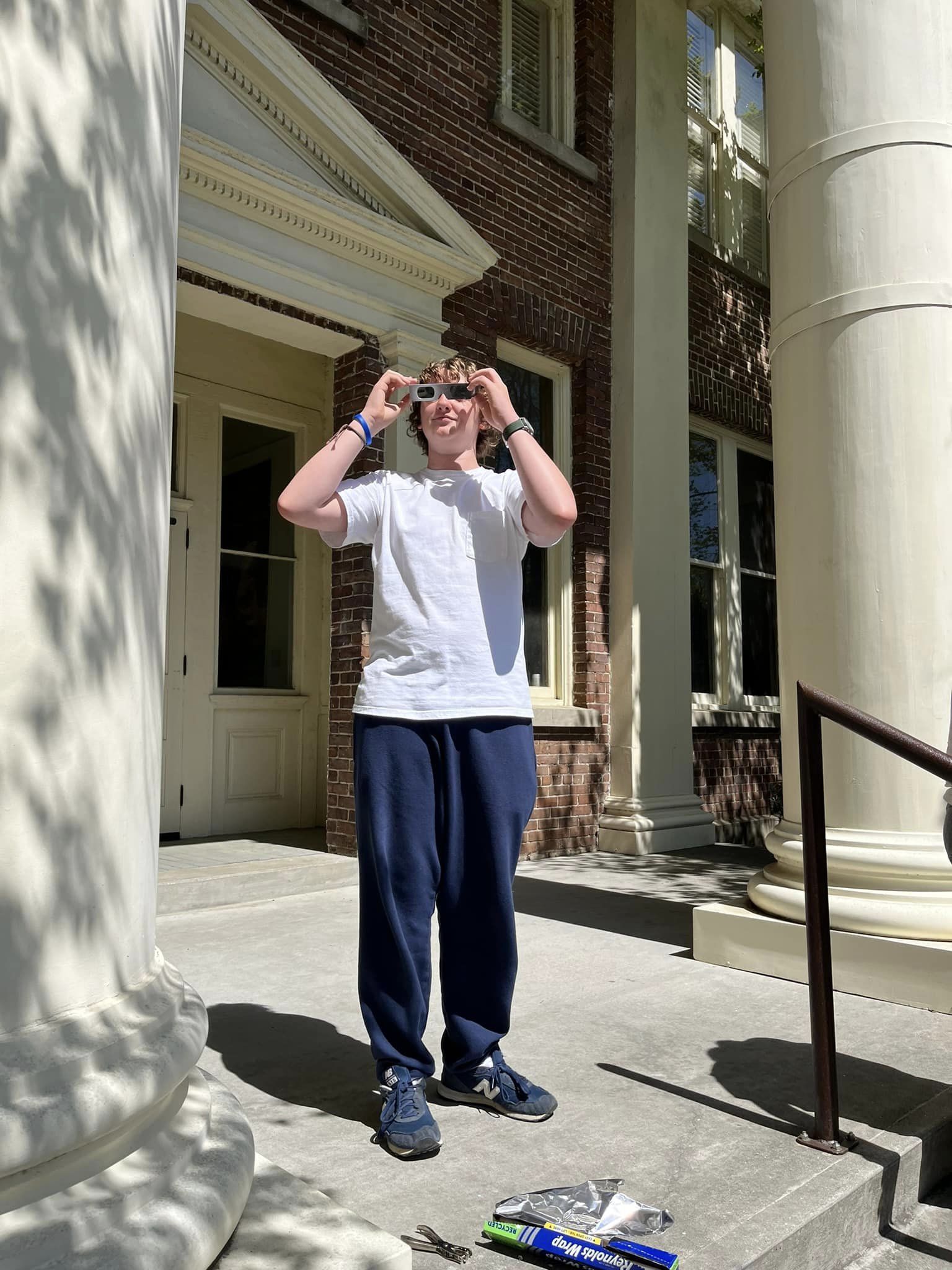
On April 8th, 2024, The Georgetown School once again got a clear view of the extraordinary solar eclipse. Students and teachers began to gather outside during sixth period, marveling at the changes in light and shadows all over our campus. The eclipse was at its peak at 3:10pm, which is after school, but lots of kids hung around to enjoy the spectacle. .
With a few pairs of official eclipse glasses, everyone was able to view this mesmerizing event. Some kids were using “pinhole cameras” to watch the progression. One student squinted up with a large piece of welder’s glass. Scott Harper from GAB News was on the scene (he had been with us in 2017 for the total solar eclipse). He took some video and interviewed Annika and Kipper on what they remembered of their experience of the total solar eclipse in 2017.
Overall it was an amazing and fun experience of nature, and we hope to see another beautiful eclipse in the future.
On March 14, TGS celebrated Pi Day. Pi (π) is the ratio of the circumference of a circle to its diameter, and its first three digits are 3.14, which is why it is celebrated on March 14. To celebrate, many students in Mrs. Crosby’s math classes brought pies to share, and some did activities related to pi. “I convinced Mrs. Crosby to watch the video 100 Digits of Pi,” Branton said proudly.
During lunch middle schoolers gathered on the porch to get slices of pie. There were two tables set out. One had nut-free pies, and the other had pies with nuts. After all the middle schoolers had gotten their slices of pie, the high schoolers were invited to participate. “It was a mountain of chocolate,” Bristol said. “It was delicious.” Students liked the apple pie and cookies & cream pie the best. Pi Day is a fun celebration that combines learning and food.
Here are a few photos of Kingfishers out and about on Spring Break.
Saylor, Sydney, and Kipper visited the North Carolina Zoo in Asheboro. “The trip was worth it because we got to see polar bears,” Saylor said.
Mme Gates and Dr. Gates visited their daughter Maddy in Washington, DC. “The cherry blossoms were magical,” Mme Gates said. They went to see a women’s professional soccer match, where the Washington Spirit defeated the Utah Royals 2-1. “It was good to see one of the players for the national team,” Dr. Gates said.
Larson flew to Canada and saw Niagara Falls. “It was very cold.” Larson said, “But Niagara Falls was worth it.”
Annika traveled to Massachusetts and also toured the University of New Haven. “The college trip was nice because I got to learn a lot more about the college and the different things you can do,” Annika said. “We did a lot of shopping in Massachusetts for the different foods they have up there that we don’t have down here.”
Sage toured Western Carolina University in Cullowhee, North Carolina. “It was beautiful. There was a nice view from everywhere on campus,” she said, “I’m really excited to go to school there next year.”
Baryck took a trip to Hunting Island, South Carolina. He also went to the Darlington Xfinity Race and took a picture of the winning car! “Loud car go fast. Loud car go vroom,” Baryck said.
The TGS school trip began Tuesday at 6:00 AM, February 26, when Sherrie (our bus driver from last year) pulled up on Cleland Street. After loading up and saying goodbye to parents, it was quiet on the bus, because everyone was tired and most of them went back to sleep. It soon became clear we were heading south—Florida? We had multiple stops for bathroom breaks. The back of the bus, where all of the high school was, didn’t get as much peace as they would have liked, because a couple of middle school rascals were spraying Axe deodorant and discussing Vietnam. “It was not a totally pleasant experience,” said Bryan.
Our first stop was St. Augustine, the oldest city in the U. S. Right before we got there, Dr. Gates divided us into four teams (led by a junior or a senior) for our annual Team Challenge. We headed over to visit the Castillo de San Marco. One of the park rangers told us that we only had thirty minutes to walk around so we’d “better not waste time in the bathrooms.” Dr. Simmons supervised the tour inside. “You, read this plaque!” he told different students as we went from room to room. Once we had finished walking through all the open rooms, we climbed to the top of the fort. There we had an amazing view of St. Augustine and the ocean. There were also a few guard towers that everyone tried to squish into.
After seeing the fort, we strolled through downtown of St. Augustine to the Lightner Museum. Our tour guide was named Bill and he was excellent. Bill told us that Henry Flagler was the man behind the building. The building first started out as the Hotel Alcazar. It was fitted for the rich but closed in 1931 due to the depression and ensuing war. Otto Lightner purchased it fifteen years later and turned it into a museum for the very odd collection of items that he had purchased throughout his lifetime. We saw all kinds of strange objects: many different seashells, minerals, musical instruments, taxidermy. There was even a baby mummy from the Egyptian era (no photos or videos were allowed of the mummy). The museum also featured a taxidermied lion named Rhoda that used to be owned by Winston Churchill. “I kind of felt like we were at Ripley’s,” said Gracin.
The Hotel Alcazar used to have an indoor pool, fed from a sulphur spring. We saw that this area is now a small café. Above the café are two more stories that feature Art Déco furniture and very fine pottery. The hotel also had a sauna that was exclusive to men and was perfectly preserved. Bill closed our tour by showing us a giant painting of the Three Fates. The painting expressed how human life hangs by a thread. “It was quite unsettling,” said Sage. Outside of the museum in the courtyard was a little pond that was full of very large koi fish. We tried to feed them but the pellet dispenser just kept taking our quarters. Except for losing a few quarters, the Lightner Museum was a great experience!
When we left St. Augustine, we headed towards Port Orange to spend the night. Port Orange had fine dining for us: dinner at Chick-fil-A! The employees made our meal a good experience. They had us go ahead and sit down, then came around for our orders. We were able to relax, talk, and enjoy a nice meal. They did a fantastic job.
After Chick-Fil-A, we walked to the Port Orange La Quinta hotel. It was a nice hotel, and even had a pool. Corrin said, “The hotel was a nice break from the bus.” The interesting thing about the hotel was that some of the rooms were connected by doors, which led to some shenanigans. After everyone got settled, some went down to swim in the indoor pool. We then went to sleep. The next day we had to be ready early, so we ate our breakfast pretty quickly and loaded up the bus.
On the second day we went to the Kennedy Space Center Visitor Complex in Cape Canaveral. Students were thrilled when they realized where we were going. Cries of “Yes! Yes! Yes!” were heard from the back of the bus. “I was smiling so much,” said Larson. “My cheek muscles hurt!” Approaching the visitor complex, we could observe the gargantuan rockets in the Rocket Garden. It was a cool and bright day, and the entrance to the complex was very intriguing, with a massive screen displaying John F. Kennedy’s passionate speech about going to the moon. After going through security, we were finally able to explore the complex. We started with a guided tour of the Rocket Garden. We learned that all of the rockets are real, and the majority of the rockets displayed were repurposed military rockets. After the garden, we split up into groups guided by one teacher and went into a museum which contained a variety of displays featuring rovers and rockets. A favorite attraction was the Space Shuttle Simulator, which Dr. Neubauer dubbed “The Shaken Baby Syndrome Simulator.” Students also enjoyed the gift shop, spending too much money on things like space helmets and space food. Corrin became The Gastronaut. We also had special appointments to do the Hyperdeck, a VR experience on the moon, which students really liked enjoyed.
Lunch was a picnic from our coolers in the picnic area of the KSC. It was a bit of a challenge, between the blazing sun and marauding birds, but we were well-fed and soon back on the bus, en route Gainesville.
After dark, we stopped on the campus of the University of Florida to go one of their cafeterias for dinner. The food was at different stations and there was a lot of variety. It did not take long for everyone to serve themselves and sit. The food was quite decent and some of the UF students were willing to talk to us. We were amazed by the size of the campus—it has 900 buildings!
By the time we finished, everyone was getting tired. We boarded the bus and headed out to what seemed to be the middle of nowhere. Our destination truly was the middle of nowhere—the Stephen C. Foster State Park in the middle of the Okefenokee Swamp. There was no light out there—just the stars. The bus pulled up into a row of cabins and we jumped off when our names were called—about ten people per cabin. The cabins had everything we needed: beds with sheets and blankets, fully-equipped kitchens, decent bathrooms and large porches. This is where we stayed for the next two nights.
On day three of the trip, we were allowed to sleep in a little bit in the absolute quiet of the Okefenokee. “That was the best sleep I ever had,” said Annika. Dr. Gates’ cabin hosted everyone for a delicious breakfast of bacon, eggs, cereal, fruit, and juice, prepared by Dr. Gates. Students brought their own plates and forks, went back for seconds, then took their plates back to wash. The day was cloudy and warm so after everyone got cleaned up, we headed outside. The Trading Post of the State Park attracted a lot of customers when it opened at 9:00.
Later in the morning, we gathered on the dock with state park rangers Alex #1 and Alex #2, who gave us each a paddle and a PFD. We partnered up and launched the canoes into a short canal leading to the swampy headwaters of the Okefenokee River. As soon as we turned the corner, we ran into wind and a strong current which made paddling extremely challenging. Some of the younger students turned back and some had to be helped back by Mrs. Crosby and Alex #2 in their kayaks.
Everyone else struggled up the river, admiring the sights and paddling like crazy. There were huge alligators all over the banks, and shore birds such as green herons, blue herons, night herons, curlews, cormorants, eagles, and buzzards. After fighting the water for a long time, we arrived at Billy Island and dragged our canoes up on the bank. It felt good to be on dry land! We wandered around and Dr. Gates gave us chocolate and water because we were missing lunch.
Alex #1 gave us a tour of the island, which is now deserted. But in the early 20th century, it was home to a settlement of 600-700 people who worked harvesting timber and naval stores. Billy Island shut done when all the trees were gone. We saw the remains of a railroad, an old car, and a water tank for the boiler.
The paddle home was a wonderful dream. We relaxed back and let the current carry us back to the Trading Post. “We still had to steer and avoid alligators,” said Baryck, “but it was a lot easier.” Dr. Simmons had taken those left behind back to their cabins. We were all dirty, cranky, and tired so we took a moment to shower and get cleaned up.
Dinner was early since we missed lunch, hosted by Mrs. Crosby and Mme Gates’ cabin. Dr. Gates served up roasted chicken breast sandwiches, beans, and potato salad to hungry students who turned up with a plate, fork, and knife. The MS occupied the picnic table behind the house, where they ate and played cards as it grew dark. HS relaxed on the porch and in the living room. Everyone eventually went back to their cabins, but some people visited other cabins to play cards or chat until lights out. People were very tired and we had an early start Friday for our trip home.
After having breakfast on Friday, everyone cleaned up the cabins, and loaded their luggage onto the bus. Once everyone and everything was on the bus, we started heading back to Georgetown. Many people spent the ride napping or talking with the people around them. Some of the middle schoolers even had a camera and were taking silly pictures of each other. The first stop we made was at a Pilot gas station, so people could use the restroom or get snacks and drinks. There were also many interesting items that students could buy, such as magnets, toy cars, and even taxidermied alligator heads, as well as several places where students could get food, such as Cinnabon and Subway.
After getting back on the bus, the seniors were given the privilege of deciding where we would have the final meal of the trip. After a brief discussion, they agreed on Zaxby’s. Dr. Gates then announced a tie-breaker challenge, since three of the teams were tied. For the challenge, he asked five questions, and each team was given one chance to give the correct answers, and whichever group got the most correct answers won. After having lunch at Zaxby’s, Dr. Gates announced that the teams would have until we passed McClellanville to submit their answers for the tie-breaker challenge. After teams had submitted their answers, Annika’s group was declared the winner. “My team has never won,” she said, “It was great to finally win after eight years!” A short while later we arrived back at school, and the tired Kingfishers gathered their luggage and left to go home. All in all it was a great trip.
On February 14, 2024, Dr. Dan Turner and Mrs. Trudy Bazemore talked to us about the renovation of the Georgetown County Library, which has been going on for over a year. We miss going to the library and are anxious for it to reopen. Dr. Turner and Mrs. Bazemore told us that the reopening may be this spring, perhaps in April. The first library in Georgetown dates from 1799, so our current library stands in a long and great tradition.
We can expect to see lots of changes when we finally go back in. One is the addition of a new auditorium, which can hold 100 people instead of 50. The new auditorium will be a great space for public programming and allow the library can host more and larger events. The old auditorium has been turned into a video editing studio, which is a very exciting development.
A film production class will be taught there to interested teens and adults once the library reopens.
Dr. Turner and Mrs. Bazemore assured us that we will love the changes. “Everything will be so fresh and different,” Mrs. Bazemore said. “We can’t wait for y’all to see it!” They closed by inviting us to help reshelve the 80,000 volumes that have been in storage all year, an offer we are going to accept gladly.
Great news! Our two robotics teams are heading to States after winning amazing victories at their respective regionals (the FIRST LEGO League and FIRST Tech Challenge). For Open Forum on January 24 and 31, the two teams shared parts of their projects with the whole school. The Angry Nerds (Middle School) showed off a working violin that they had made and sang a song they had written about their project to the students. The Kingfishers (High School) brought down their robot to the Auditorium and put it through its paces. Everyone could watch it hang up a ring, throw a paper airplane, and suspend itself. We really enjoyed seeing both team’s hard work first-hand and congratulating them on their victories.
The good news started with Middle School in the FIRST LEGO League. On January 20 at Cane Bay High School, the Angry Nerds took a first place for their project to 3D print musical instruments so that any student could afford to buy one and learn to play. They did a great job researching the project and finding out that musical instruments and education are beyond the means of many families. The team figured out how to 3D print a violin and put on its bridge, strings, and pegs for about $60. Does the violin sound good? The manager at Andy Owings Music Store thought the quality was fine for student learners.
The team is now working on increasing the speed of their robots to try to do better in the robot part of the competition. We wish Mrs. Crosby, Dr. Neubauer, and the Angry Nerds all the best when they compete again February 17.
The Kingfishers, our high school team, headed for Dorchester High School in North Charleston on January 27 to compete against 21 other teams with their robot Phred in the FIRST Tech Challenge. Their competitions took place all day with almost no down time. Phred did his jobs exactly as he was supposed to and the Kingfishers found themselves in the final round competing for first place! We didn’t quite make it but we are still going to States, having brought home the second-place overall trophy.
Good luck to Dr. Gates and the “Nerd Herd as they head to Columbia on March 2.
Our first guest speaker of 2024 was our own Ella Cheek. Ella graduated from TGS just last year and is the winner of our 2023 Senior Speech Award. Florida State is now her school and she had quite a lot to share about her experiences so far. Ella chose Florida State because it is strong in humanities and is a total change. So far, Ella, has been very happy down in Tallahassee.
Ella mentioned social changes she has had to face at Florida State after her time at TGS. The campus at Florida State is very large, with students commuting to class on electric scooters, the bus, and in cars. Ella said that when she first arrived, she had no friends. “I was lonely,” she said. “The only person I knew the first week was my roomate.” She realized that going to events and joining clubs was the only real way to find and make friends on a large campus. Luckily, she has ended up with a bunch of new friends after attending an engineering event.
College classes at Florida State are so large that it is nearly impossible to have a one on one conversation with the professor. Ella told us to cherish the ability to be able to talk with our teachers. Ella was also shocked to see how much technology is used in the modern college classroom. She quickly got the hang of it but she was not used to depending on her computer so much. Now that the transition is over, she has been having a great time.
Ella’s classmates Isaac and Kelsi were with us also for Open Forum. Everyone was glad to see them. Thank you all for the visit and thank you, Ella, for sharing your school experiences! Go Seminoles!
Just after Thanksgiving break on November 29, we were introduced to Giany Guedjo, our guest speaker for Open Forum. He is currently the executive director at Carolina Human Reinvestment, a non-profit organization that specializes in promoting healthy lifestyles for kids in Georgetown County. He is also a talented linguist and speaks over 10 different languages. When he was a recent immigrant to the US, he learned to speak English in one year and three months at his first job over here, making sandwiches at Subway.
Giany was born in Bénin, a French-speaking country in West Africa between Ghana and Nigeria. Before emigrating from Bénin to the United States with his wife, Giany overcame very difficult conditions to get an education in Africa. For example, at his university in Bénin there were 2500 students in some classes. “Students broke windows to get in and get a good seat,” he said. “There were only 100 books for all those students.” After graduating as valedictorian, he worked at an orphanage and taught farmers how to market crops. Fourteen years ago, his wife won the US Immigration Lottery and they decided to move here.
Life is not easy for immigrants and Giany and his wife were no exception. The job at Subway allowed them to survive until Giany could get enough English to go back to school. He then got a Masters of Business Administration from Webster University. Even then, it wasn’t easy to find work. Giany learned of the job at CHR almost by accident but it is a great fit for him and he is now the proud executive director of this community nonprofit in both Georgetown and Pawleys Island.
One of CHR’s projects is community gardening. There are gardens in Georgetown, Pawleys Island, and at several area schools. People from the community and students can take home fresh produce and eat healthier, better-tasting food. “Food is medicine,” said Giany. CHR also sponsors comprehensive after-school programs where elementary students can do their homework and practice their reading. Giany invited us to come read with kids as community service. CHR also has helped older kids find after-school and summer jobs in the community and managed the FoodShare program to help food-insecure families.
Giany told us that you should have fun in life, but you should get your work done first. He has a particular philosophy to conquering life, which is “when you do something, do it the hard way.” This is accompanied by a list of four rules: sleep hard, eat hard, play hard, and most importantly work hard. We would like to thank Giany for being our guest speaker for Wednesday and giving us the opportunity to do more community service with the CHR.
You must be logged in to post a comment.